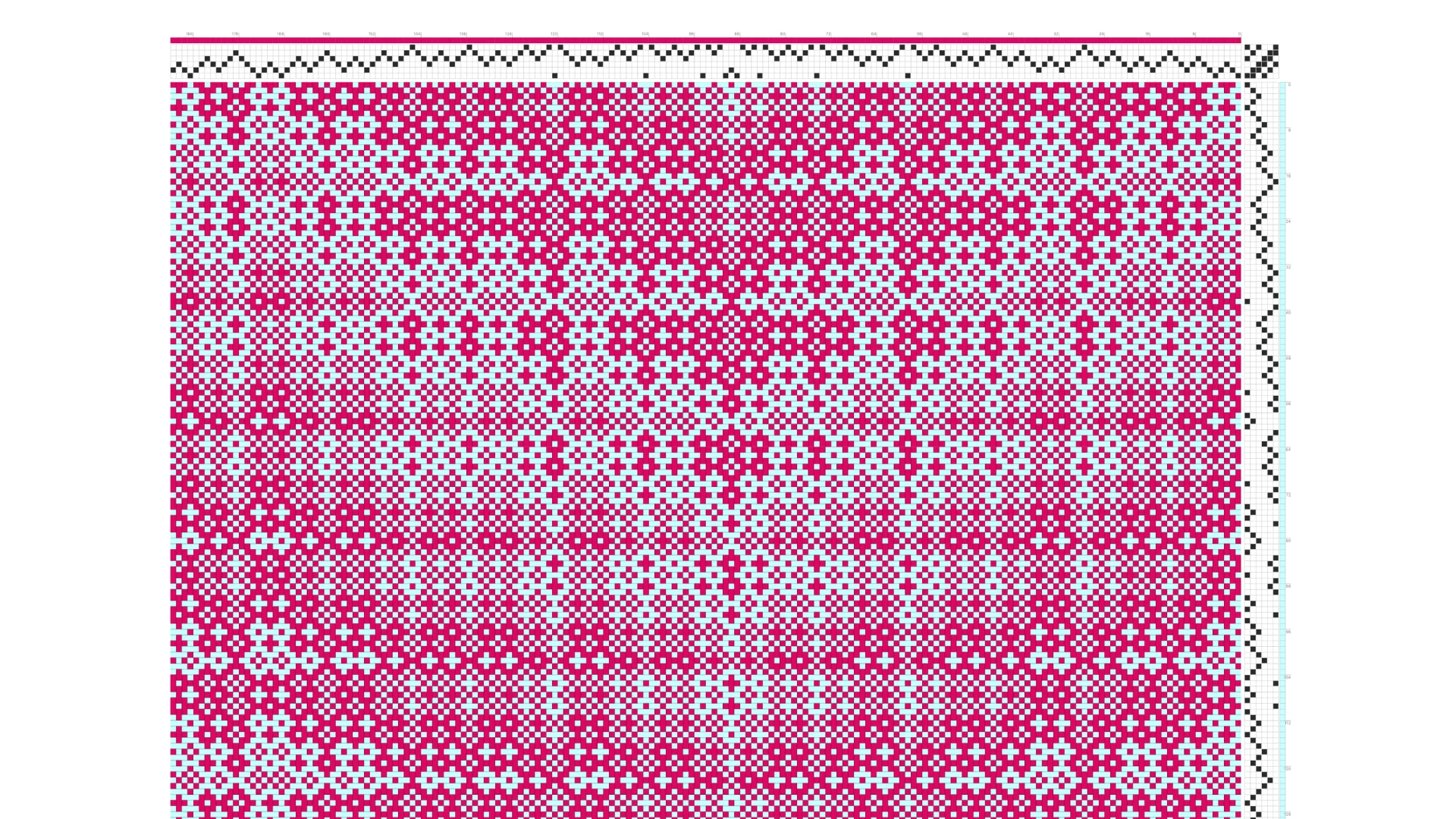
I den här handledningen lär du dig grunderna i jämtlandsdräll, som skapar några av de mest intrikata och fascinerande mönster som är möjliga med bara fyra eller åtta skaft. Då sätter vi igång!
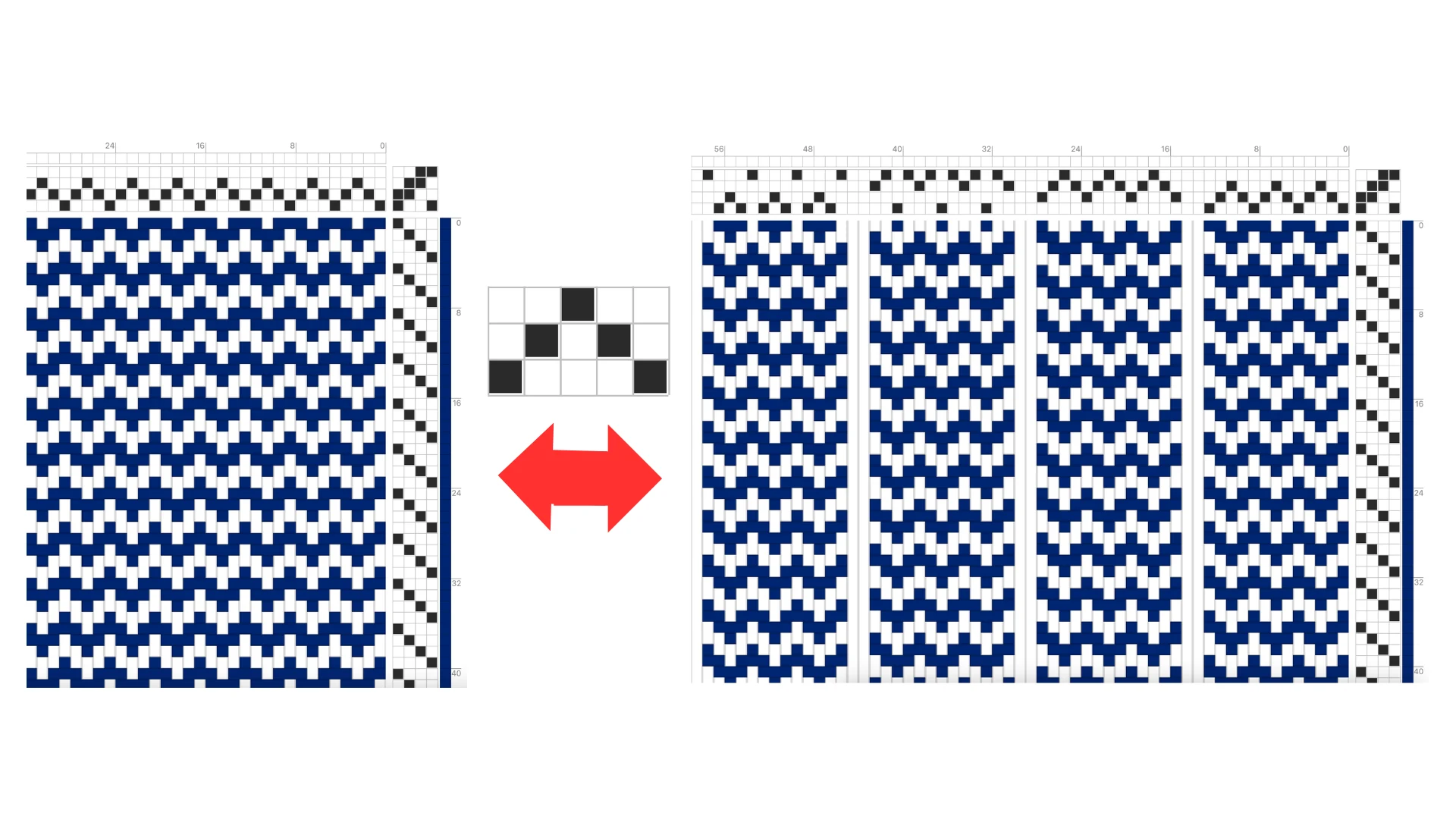
Vi börjar med att förklara mekaniken bakom jämtlandsdräll och var den kommer ifrån. Jämtlandsdräll bygger på trepunktskyperten som du kan se i bilden till vänster.
Med fyra skaft kan vi få fyra olika sorters trepunktskyperter beroende på vilken grupp av i följd liggande skaft vi använder, dvs. 1-2-3, 2-3-4, 3-4-1 eller 4-1-2. De är förskjutna versioner av varandra.
Jämtlandsdräll handlar helt och hållet om att kombinera dessa olika spetskyperter för att bygga komplexitet.
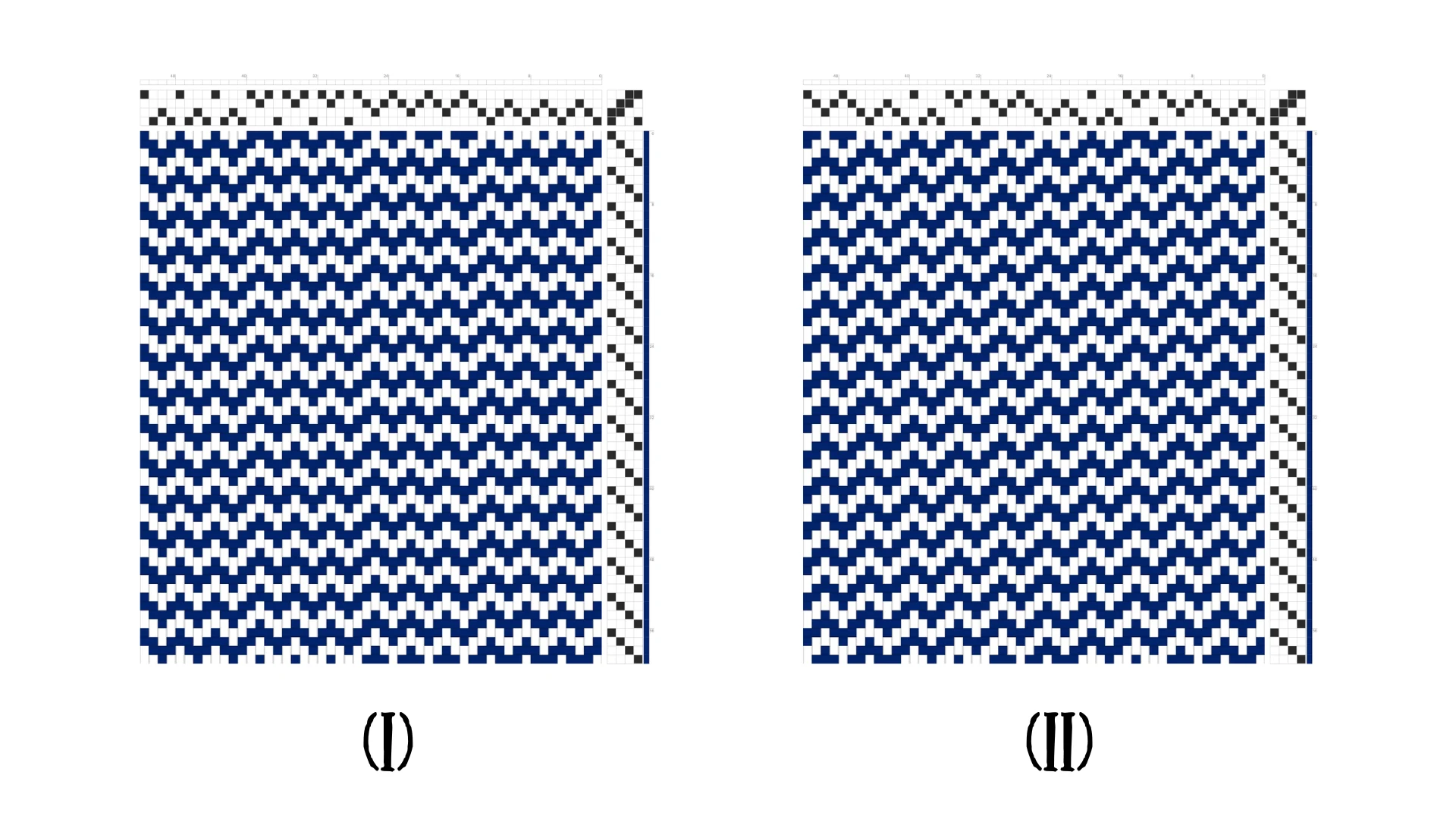
Här ser du hur vi utvecklar komplexa jämtlandsdräll-mönster med utgångspunkt i att kombinera de olika spetskyperter som är möjliga på fyra skaft.
I (I) kombinerar vi de fyra trepunktskypert-vävarna som kolumner sida vid sida. Solvningen kan ses som en grundläggande jämtlandsdräll-sekvens. I (II) krymper vi varje kolumn till bara en rapport av varje trepunktskypert. Nu är solvningen en mer intressant jämtlandsdräll-sekvens. Vi ser att spetskypert-mönstret blir ett stigande sicksackmönster i vävnotan.
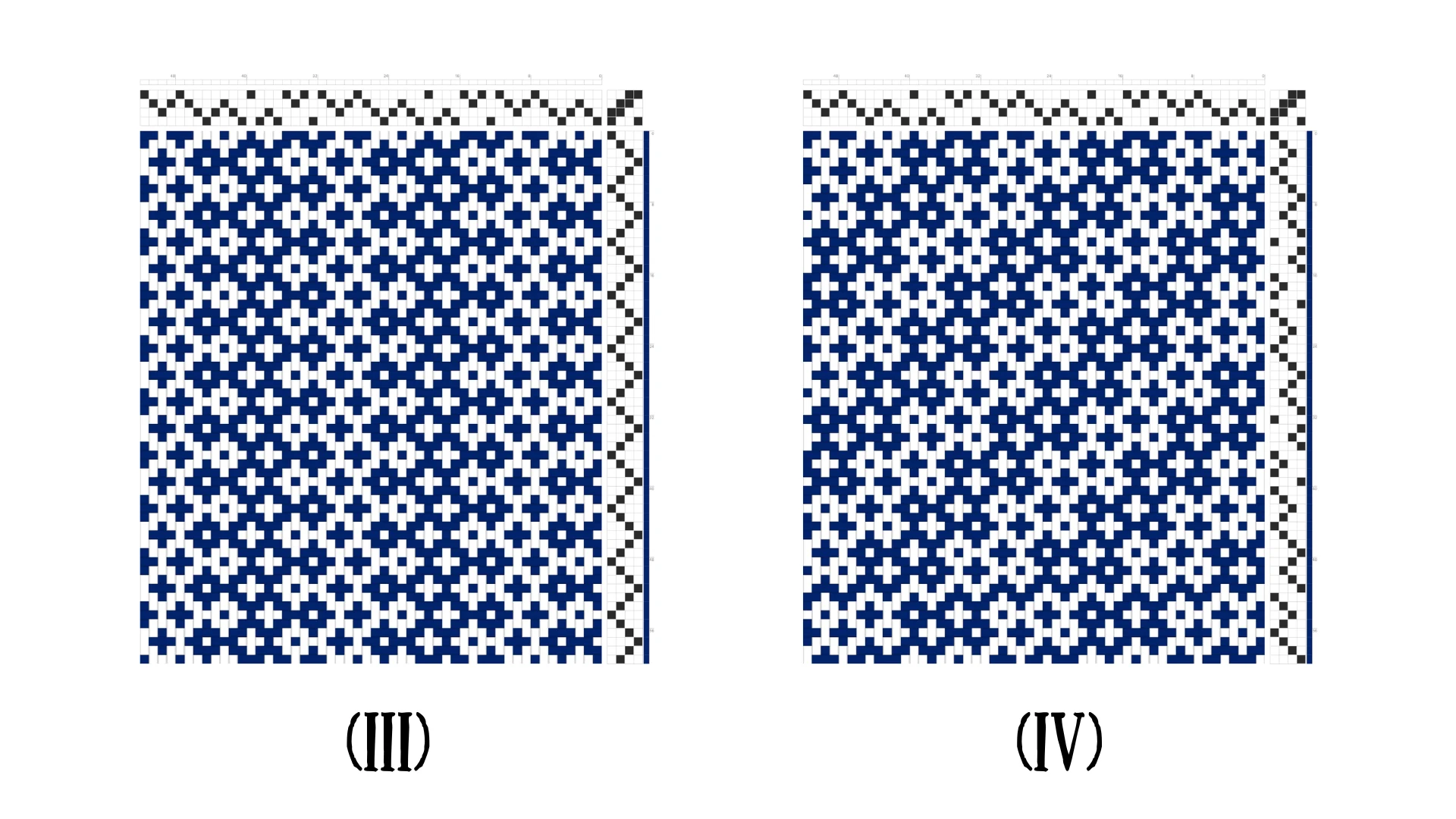
I (III) byter vi från en rak solvnings-trampning till en spetskypert-trampning. Jämtlandsdräll-solvningen och spetskypert-trampningen samverkar och framkallar interferensmönster i vävnotan. Så uppträder jämtlandsdrällens signaturplus ("+") och -punkter ("·").
I (IV) använder vi jämtlandsdräll-sekvensen i solvningen även som trampning (även kallat trampa som solvad). Jämtlandsdräll-mönstren blir nu verkligt komplexa.
Förhoppningsvis har detta väckt ditt intresse för att lära dig jämtlandsdräll. Nu dyker vi ner i detaljerna.
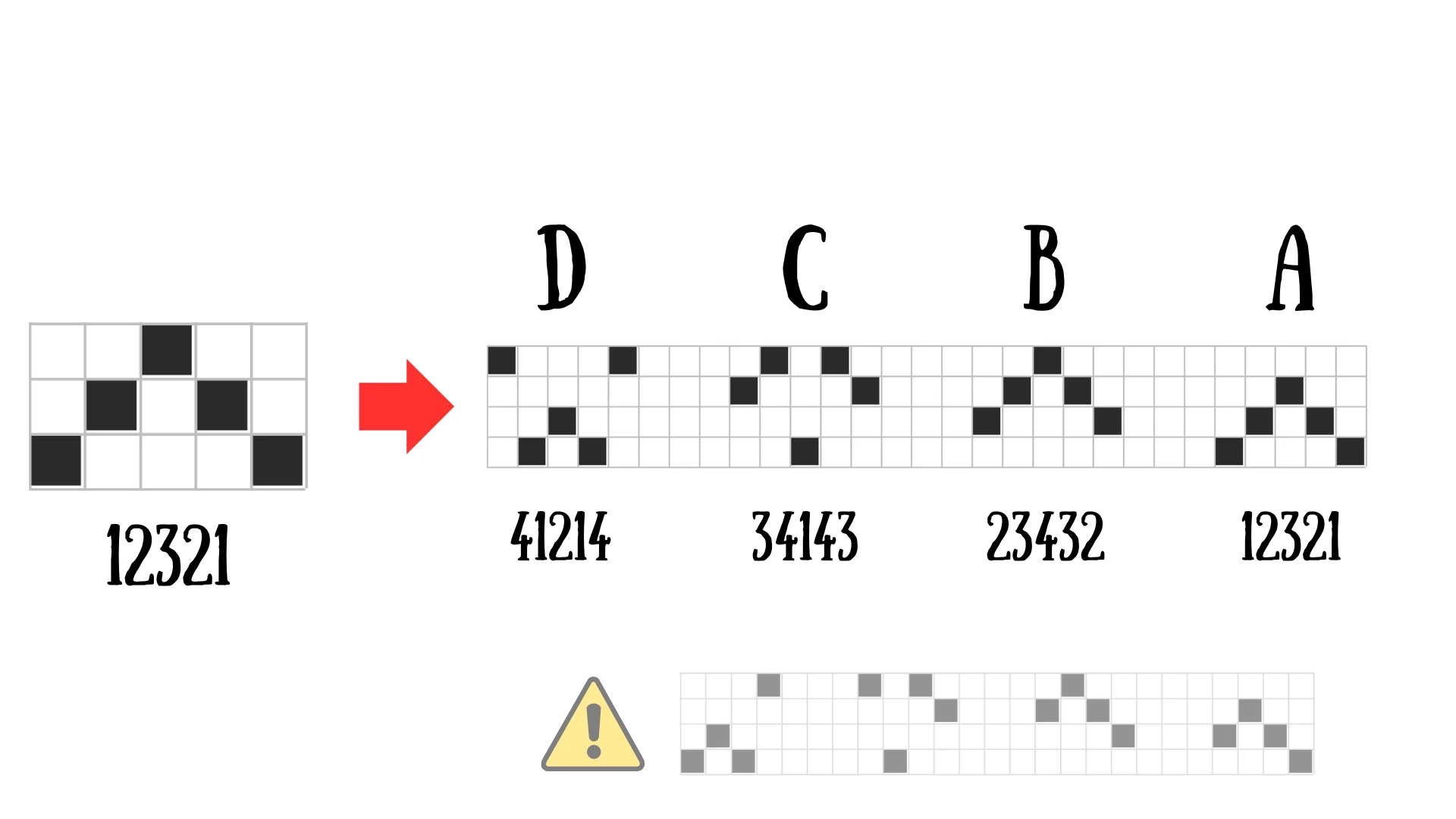
Jämtlandsdräll är en profilpatron, vilket betyder att vi kan komponera jämtlandsdräll från enkla byggstenar, nämligen trepunktskyperten.
Antalet block blir det slutliga antalet skaft som krävs. För en fyrskafts vävstol kan du arbeta med upp till fyra block A, B, C och D. Deras sekvenser är: 1-2-3-2-1, 2-3-4-3-2, 3-4-1-4-3 och 4-1-2-1-4.
Obs: jämtlandsdräll lärs oftast ut med fyra-breda block (t.ex. 1-2-3-2, 2-3-4-3 osv.) i stället för fem-breda block. Vi tycker dock att det fyra-breda perspektivet är svårare att förstå. Du kan se Griswolds resurser om jämtlandsdräll för det fyra-breda perspektivet.
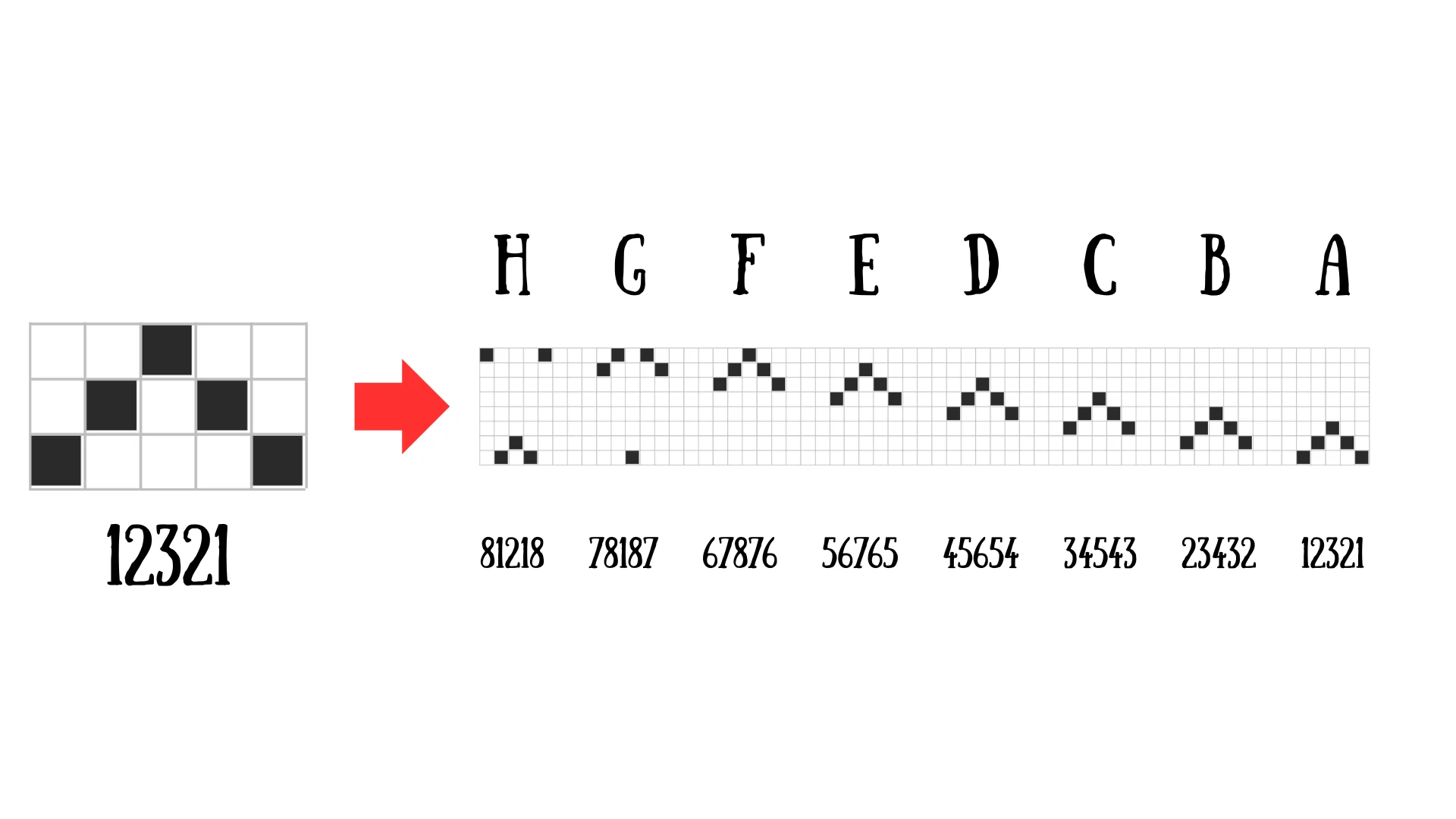
För en åttaskafts vävstol kan du arbeta med upp till åtta block A, B, C, D, E, F, G och H. Deras sekvenser är 1-2-3-2-1, 2-3-4-3-2, ..., 7-8-1-8-7 och 8-1-2-1-8.
Du ser hur denna regel generaliseras till valfritt antal skaft.
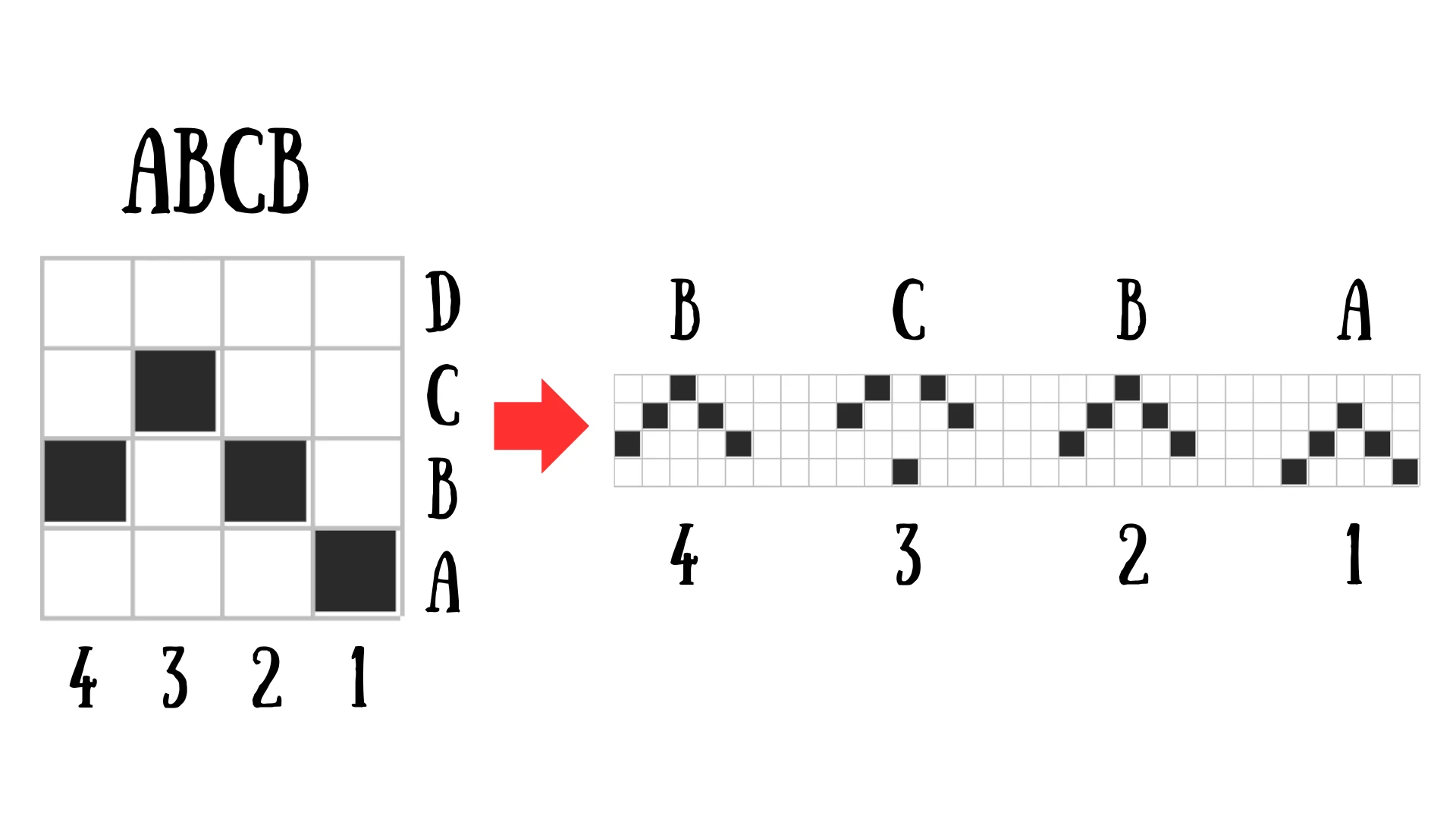
För att komponera jämtlandsdräll med block skriver vi ut sekvenser av block i en profilpatron. I bildens vänstra halva har vi en profilpatron-solvningssekvens med blocken A-B-C-B. Lägg märke till att varje "skaft" i profilpatronen motsvarar ett annat block.
Vi ritar vår solvning från höger till vänster enligt vanlig konvention.
Sedan vill du, för varje block i profilpatronen, ha dess expanderade version som du kan se i bildens högra halva.
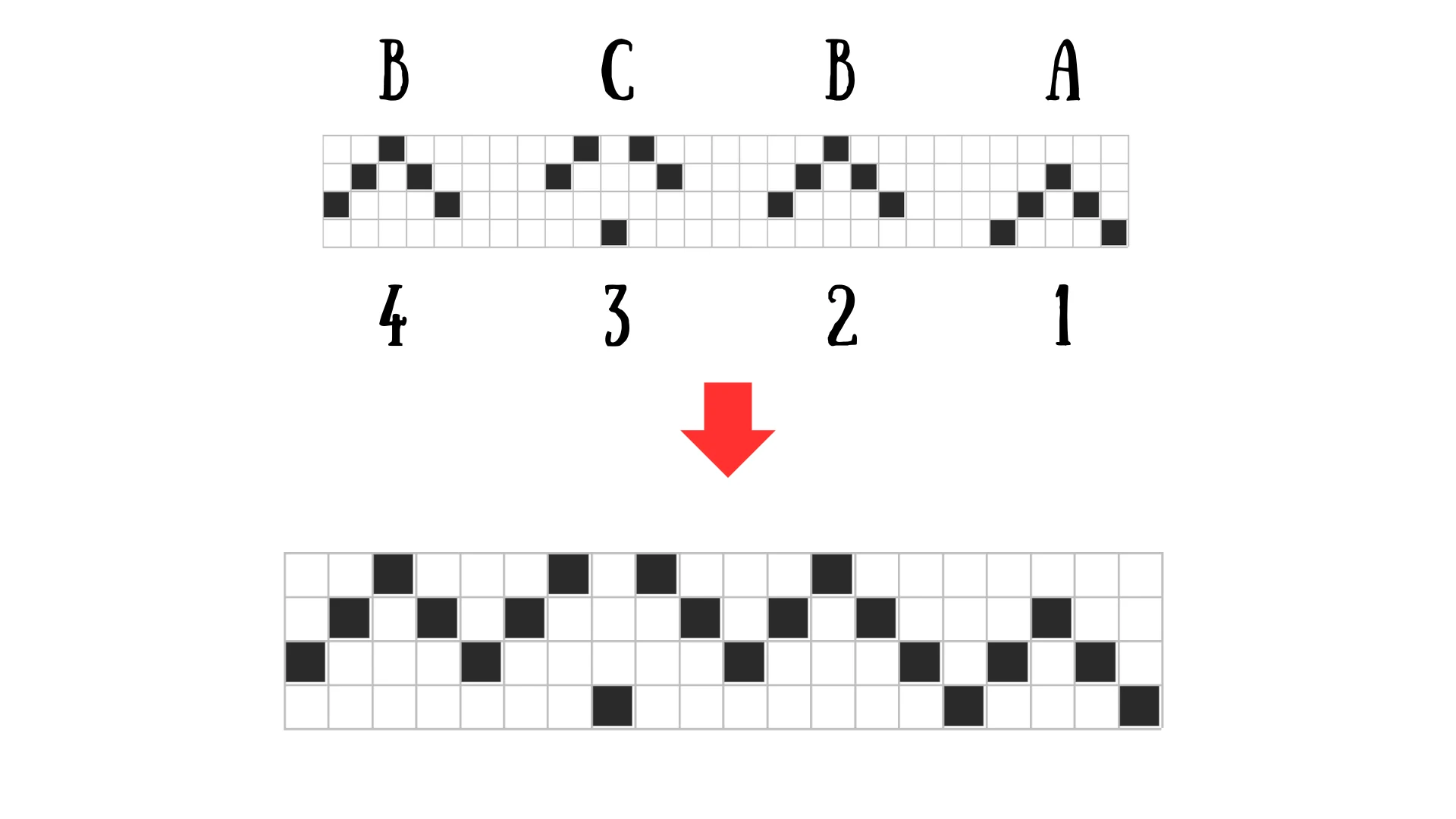
För att slutföra expansionen av profilpatronen fogar vi helt enkelt samman de expanderade blocken för att få vår slutliga sekvens.
För att upprepa: vi började med en profilpatron-sekvens A-B-C-B. Vi expanderade blocken vilket gav oss 12321-23432-34143-23432. Sammanfogning ger oss vår slutliga sekvens 12321234323414323432. Hela denna process är blocksubstitution för jämtlandsdräll.
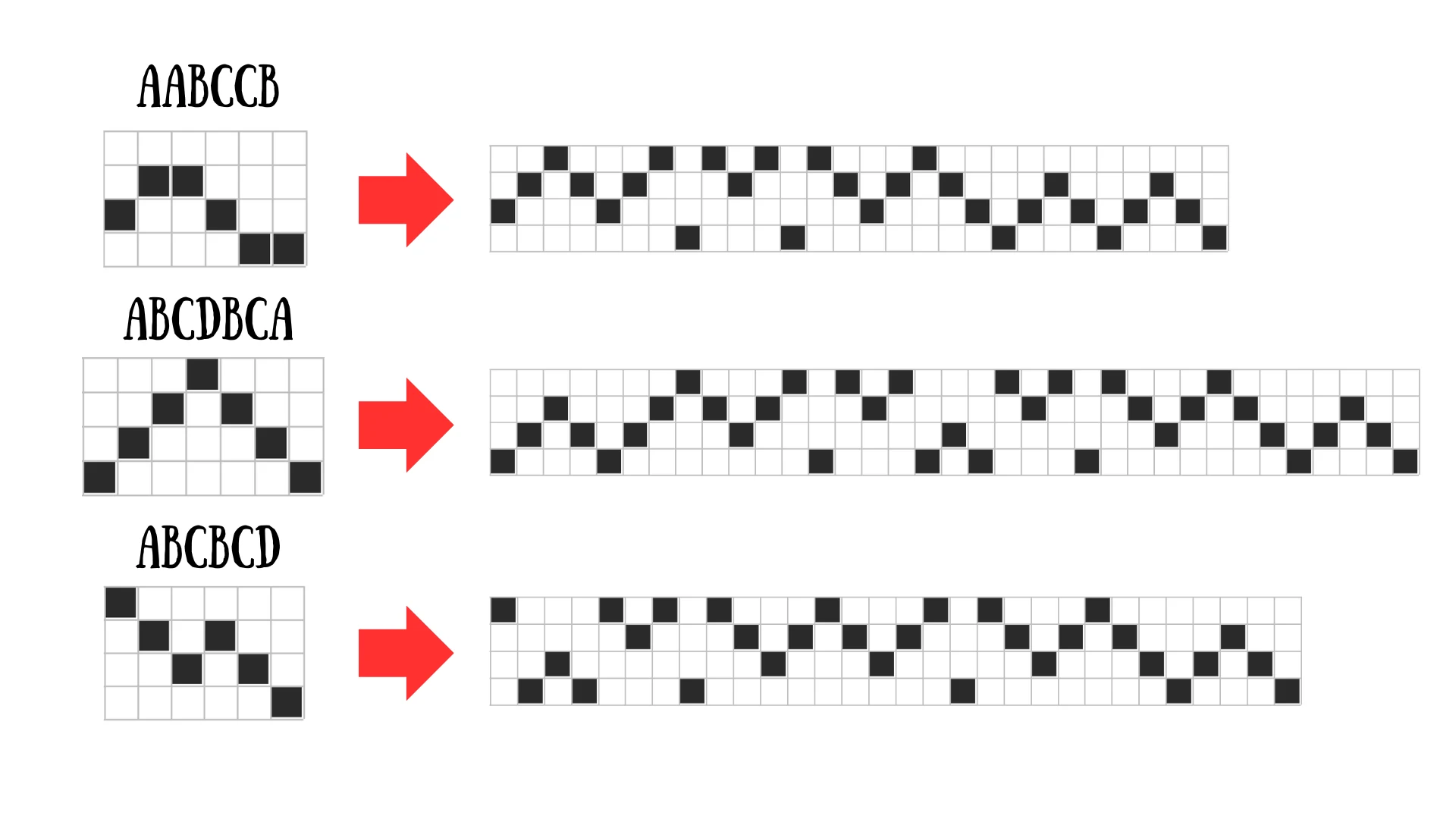
Här demonstrerar vi tre profilsekvenser till (till vänster) där vi utför blocksubstitution för att få de expanderade jämtlandsdräll-sekvenserna respektive (till höger).
Lägg märke till att för block i följd som A-A slår vi ihop den upprepade siffran (dvs. 1-2-3-2-1-1-2-3-2-1 blir 1-2-3-2-1-2-3-2-1). På samma sätt för C-C blir 3-4-1-4-3-3-4-1-4-3 till 3-4-1-4-3-4-1-4-3.
Vidare måste profilsekvenserna för jämtlandsdräll vara "stegvisa". Det vill säga, i en profilpatron kan du efter A stanna kvar på A, gå till B eller gå till D. Så AABBAA är giltig men ACA är inte giltig. Som ett annat exempel är ABCDA giltig men ABDA är inte giltig. Med fyra skaft kan du inte hoppa mellan A-C och B-D.
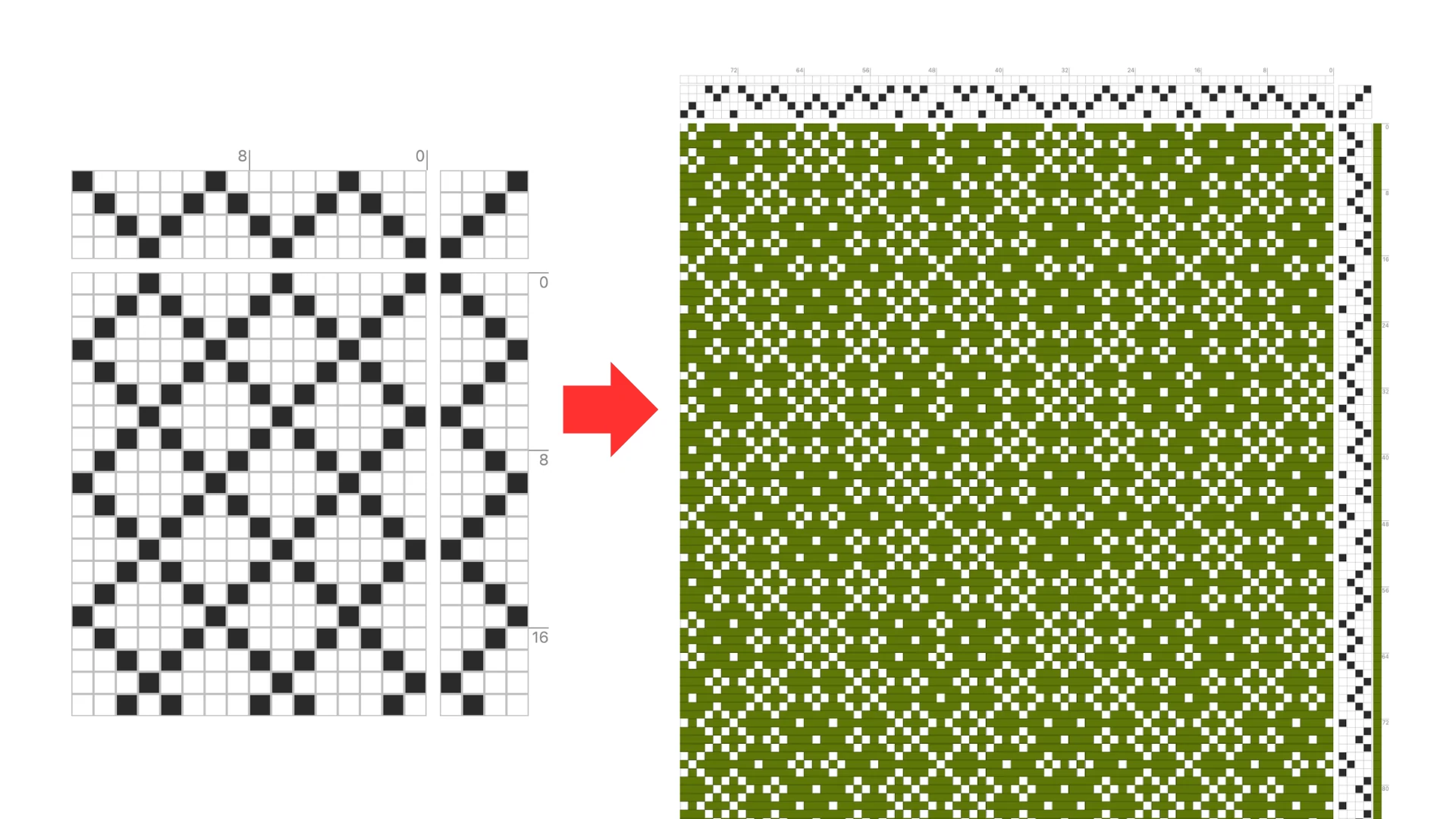
Låt oss nu betrakta hela profilpatronen. Att utföra blocksubstitution på både solvningen och trampningen i en profilpatron ger oss en fullständig jämtlandsdräll-vävnota.
Som du ser följer den expanderade vävnotans komplexa visuella uttryck i stort sett formen på profilpatronens vävnota. På så sätt kan du planera den övergripande strukturen i en profilpatron och sedan expandera för att se det slutliga resultatet.
Här har jag en 3/1 kypert-uppknytning som ger en varpeffekt-design. Profilpatronens uppknytning kopieras helt enkelt över till den slutliga expanderade vävnotans uppknytning.
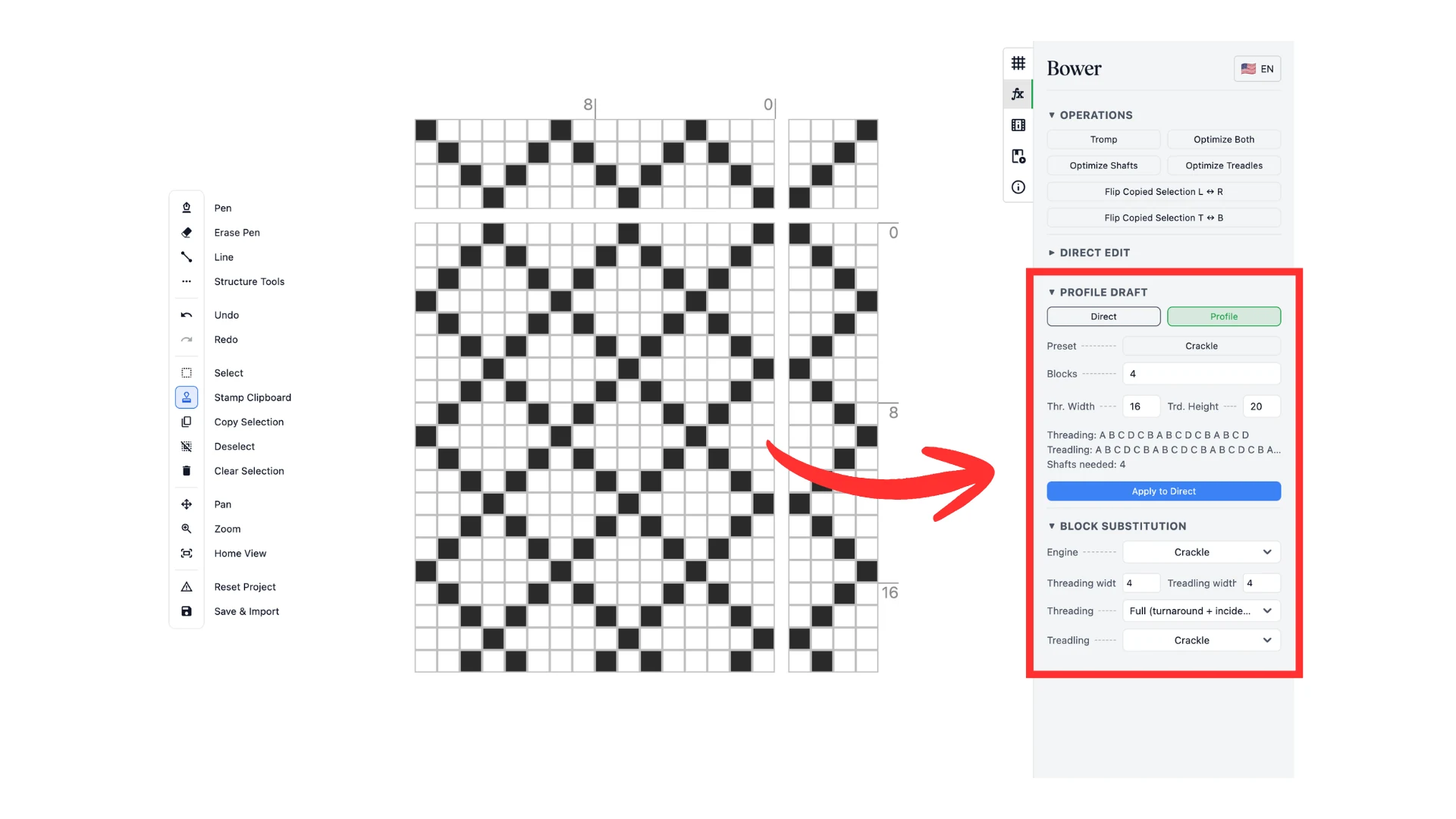
Att manuellt expandera profilpatroner kan vara extremt tröttsamt och felbenäget, särskilt för större vävnotor. Att använda ett vävprogram som Bower, som har automatiska blocksubstitutionsfunktioner, är ett av de bästa sätten att effektivt skapa jämtlandsdräll.
De expanderade jämtlandsdräll-vävnotorna i den här handledningen skapades alla i Bower.
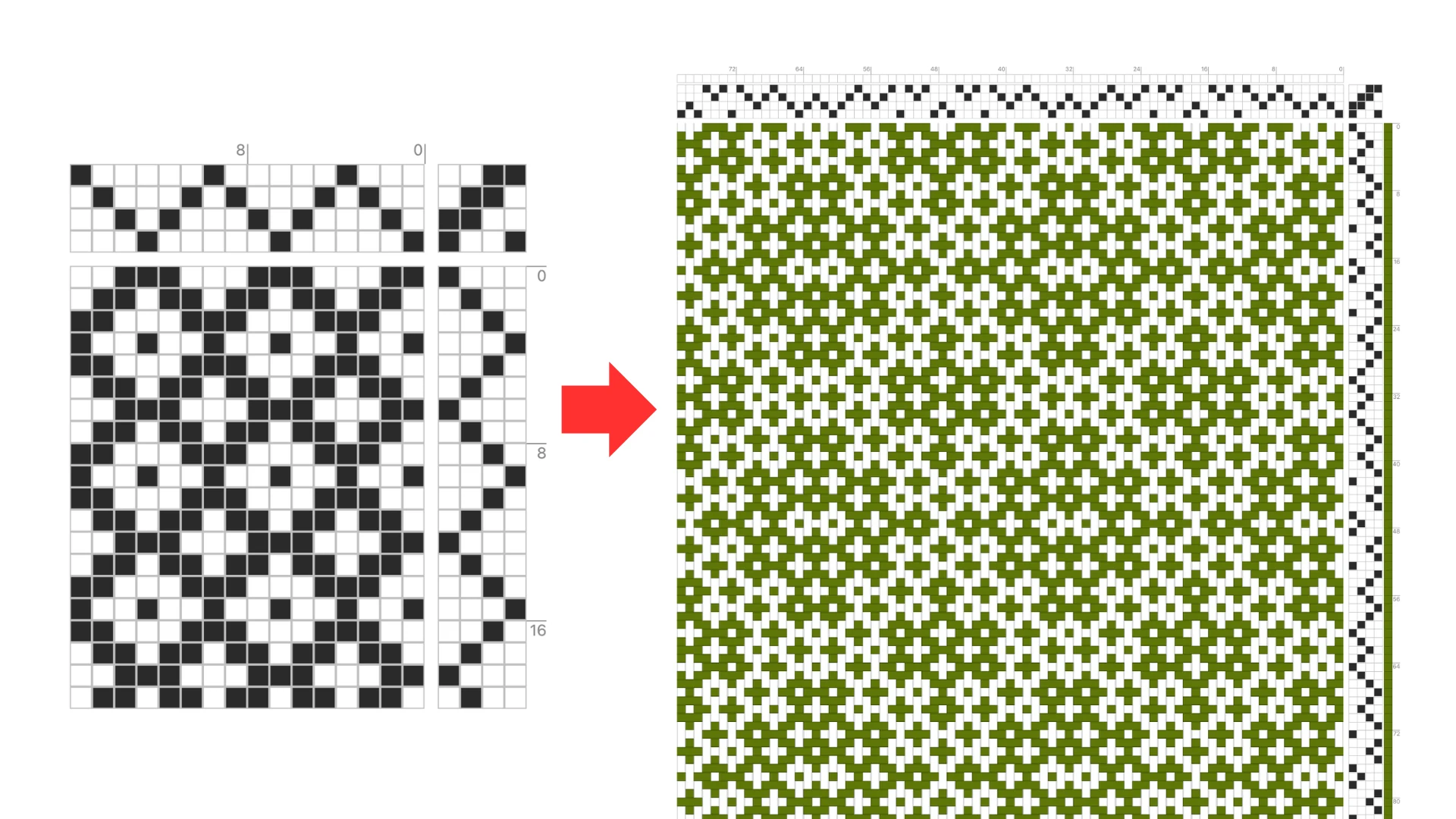
Här har jag en 2/2 kypert-uppknytning som ger en balanserad design, och jämtlandsdräll-mönstret kommer verkligen till sin rätt här.
Jämtlandsdräll använder traditionellt kypert-uppknytningar, men de är bara en utgångspunkt. Experimentera med olika uppknytningar för att se vilka effekter de kan ge. Ett vävprogram som Bower är till enorm hjälp eftersom det automatiskt kan beräkna din vävnota, och du kan därmed experimentera live.
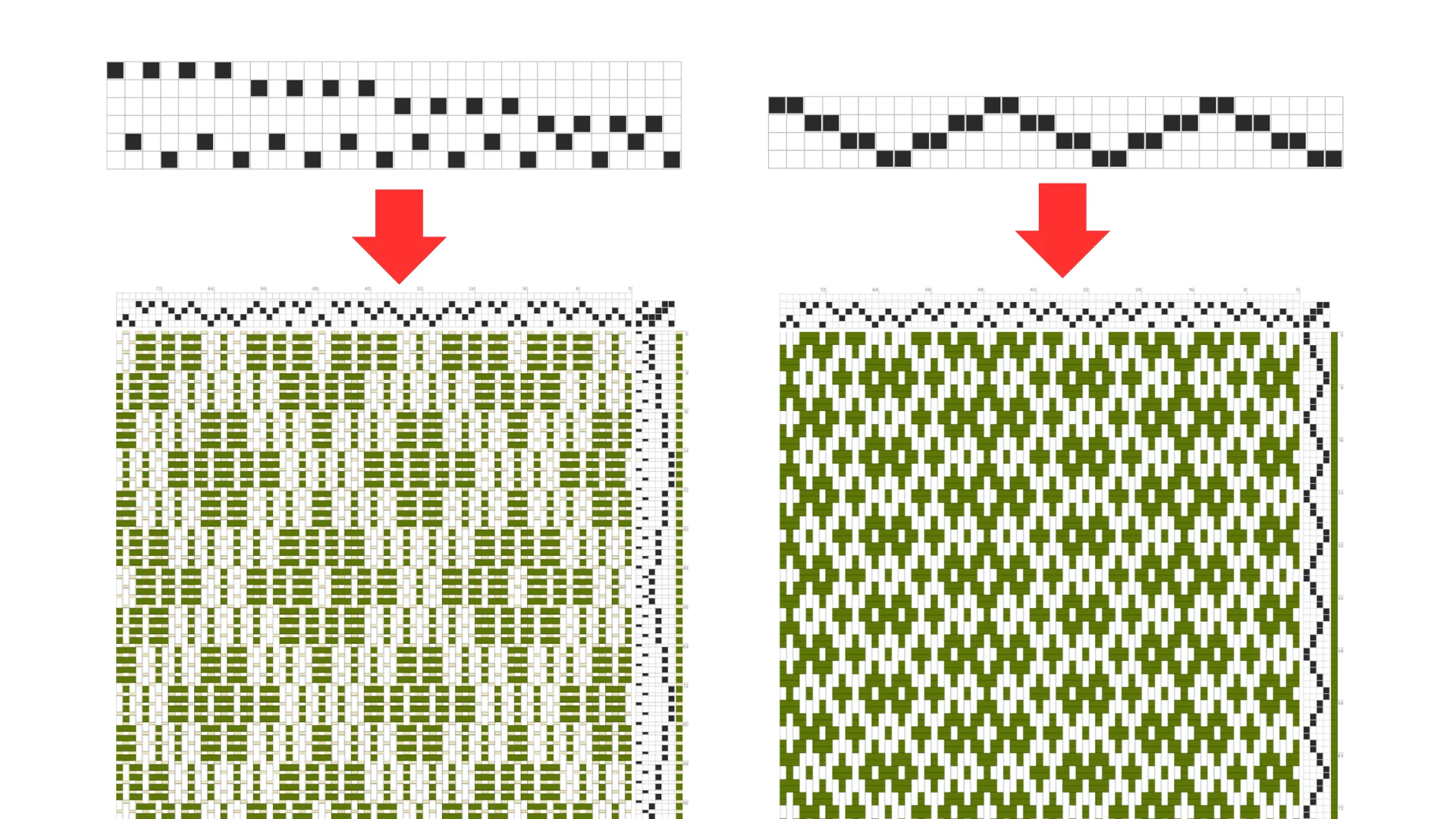
Du kan också prova olika trampningar när du ritar upp jämtlandsdräll. Till vänster använde vi ett standardmönster för kuvikas-trampning. Här är våra trampningsblock A=1-3-2-3, B=1-4-2-4, C=1-5-2-5 och D=1-6-2-6.
Till höger använde vi ett förlängt spetskypert-trampningsmönster 1-1-2-2-3-3-4-4-3-3-2-2. Olika trampningsmönster skapar olika interferensmönster med jämtlandsdräll-solvningen.
Ändå ger användning av jämtlandsdräll-trampningar med jämtlandsdräll-solvningar de mest dramatiska, komplexa effekterna i ditt tyg.
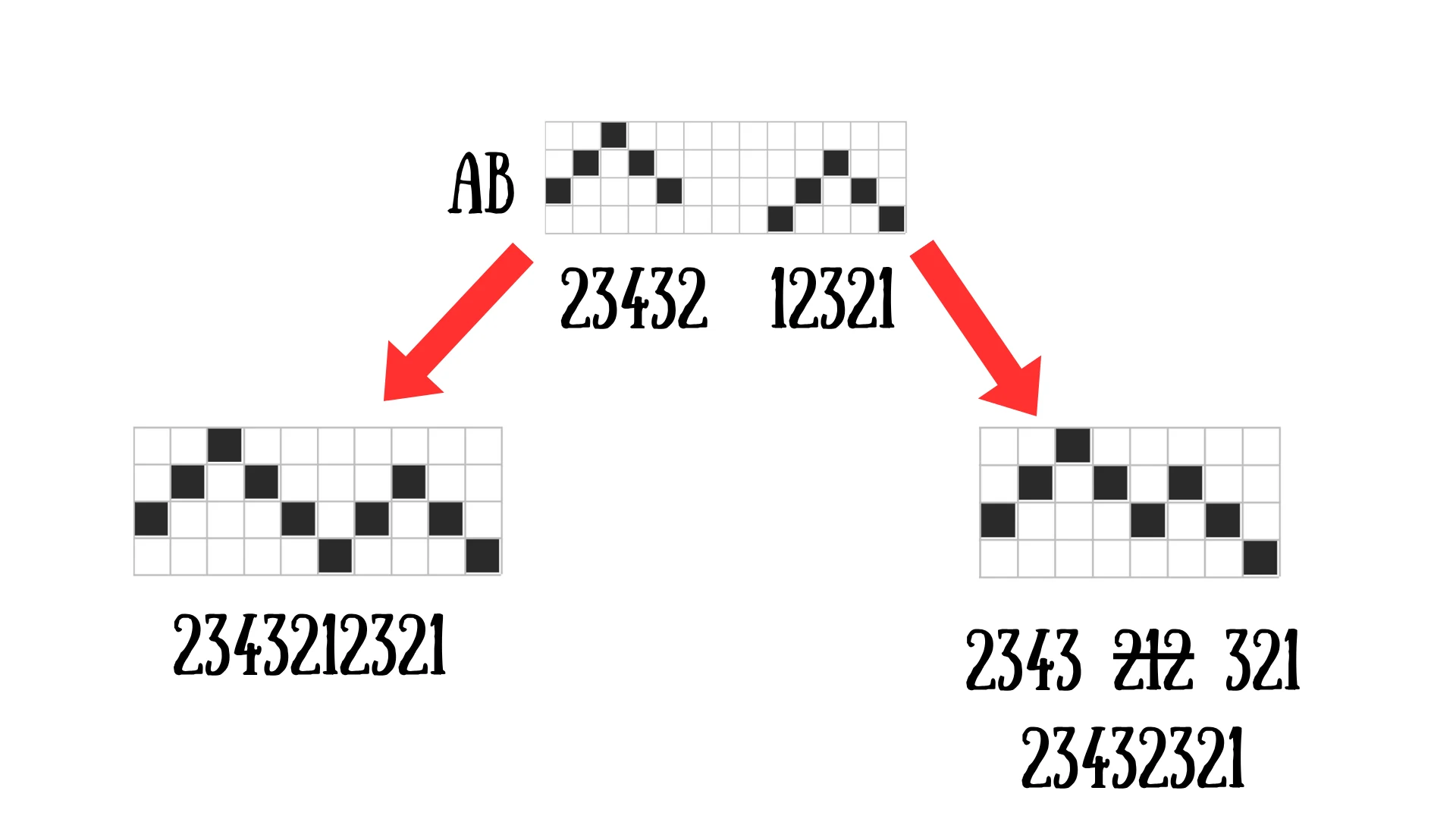
I jämtlandsdräll kan sammanfogning av blocken även ta en andra, mer kompakt form. För två block A (1-2-3-2-1) och B (2-3-4-3-2) lärde vi oss tidigare att foga samman dem för att få 1-2-3-2-1-2-3-4-3-2.
Vi ser dock att vi kan "slå ihop" dem genom att ta bort den mellersta 2-1-2 för att få 1-2-3-2-3-4-3. Jämtlandsdräll-sekvenser är giltiga så länge sekvensen rör sig upp eller ner med ett skaft varje gång.
Mer formellt: ta den första siffran i det andra blocket (t.ex. för B är det 2). Sök efter den sista förekomsten av den siffran i det första blocket (t.ex. för A är det 1-2-3-*2*-1). Skala sedan bort från den sista förekomsten och framåt (t.ex. 1-2-3) och foga samman med det andra blocket (t.ex. 1-2-3 med 2-3-4-3-2).
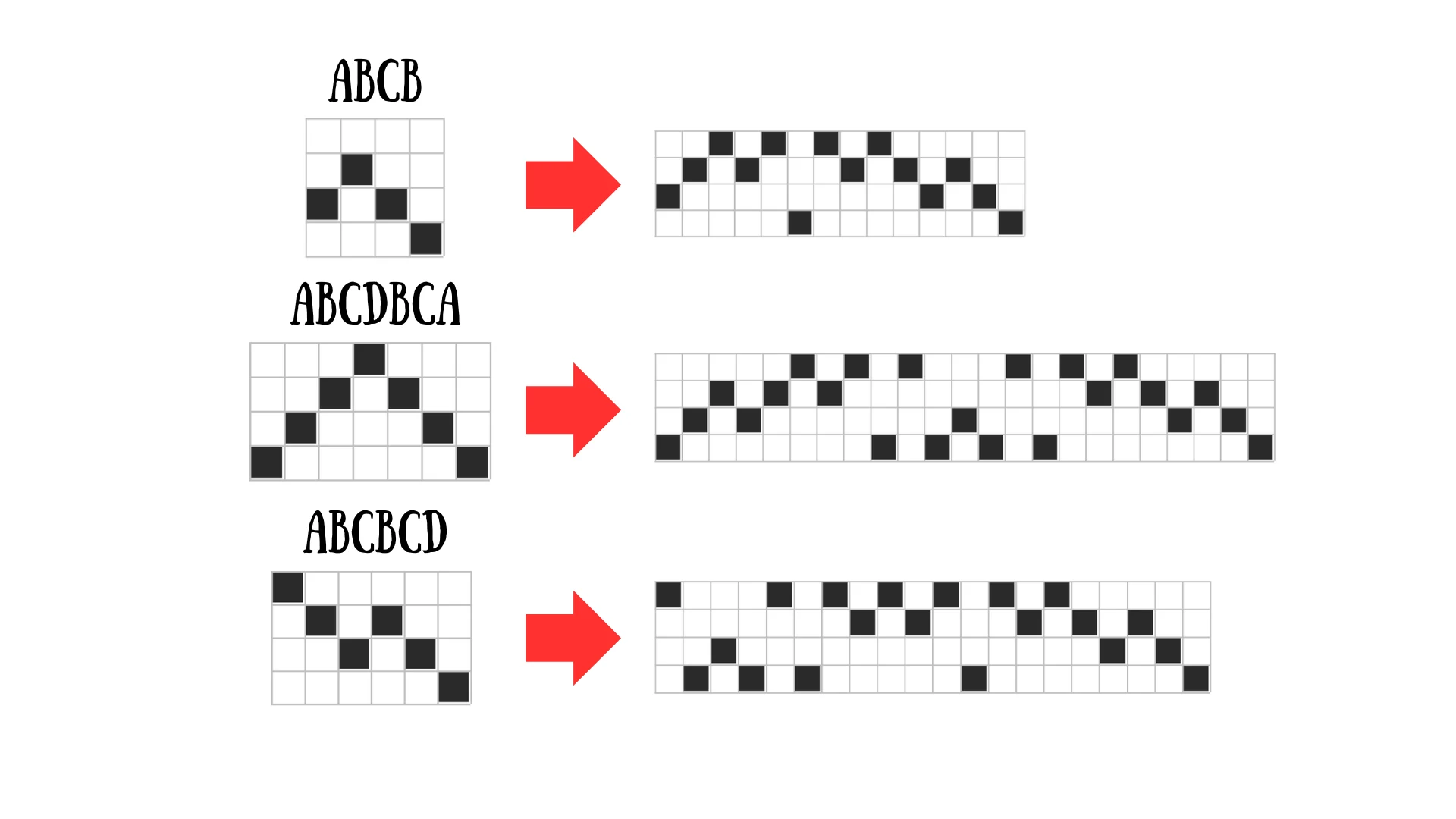
Här demonstrerar vi tre profilpatroner till (till vänster) där vi utför den kompakta versionen av jämtlandsdräll-blocksubstitution för att få de fullständiga jämtlandsdräll-sekvenserna respektive (till höger).
Du kan blanda och kombinera de två sätten att foga samman jämtlandsdräll-blocken för att få intressanta designer.
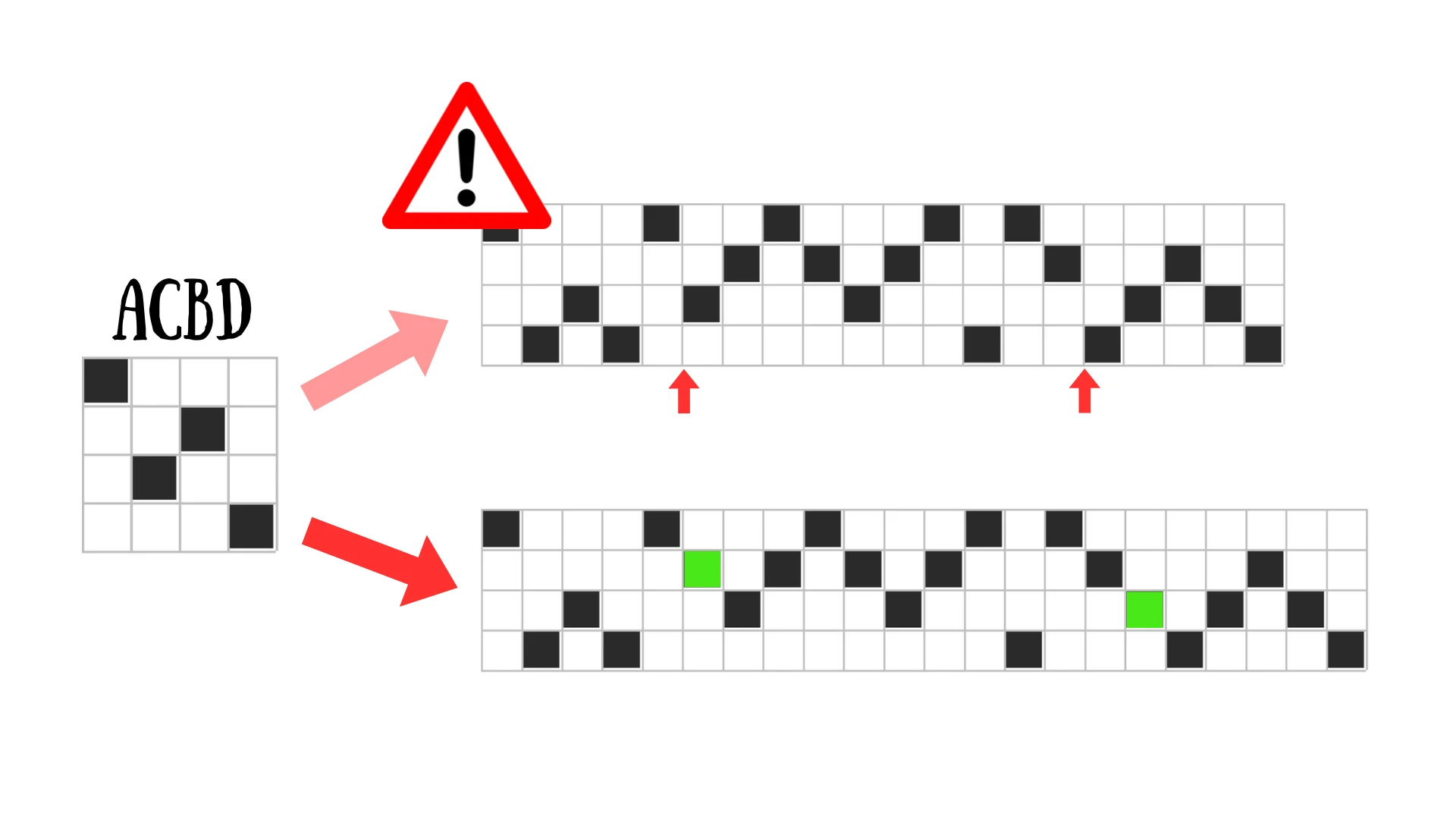
Tidigare nämnde vi att profilsekvenser inte kan hoppa mellan A-C och B-D på fyra skaft. Vi introducerar nu ett begrepp som kallas *förbindelsetrådar (incidentals)* som kan förvandla "ogiltiga" sekvenser som ACBD till giltiga vid blockexpansion.
Lägg märke till i bildens övre halva att om vi substituerar våra block som tidigare uppstår diskontinuerliga gap i jämtlandsdräll-sekvensen. Detta är inte tillåtet i jämtlandsdräll.
För block som hoppas över infogar vi den första siffran i det blocket. Detta är en förbindelsetråd (incidental). Så för en profilsekvens A-C har vi normalt 1-2-3-2-1 och 3-4-1-4-3. Eftersom vi hoppade över block B infogar vi dess första siffra (2) mellan de två expanderade blocken. Detta resulterar i 1-2-3-2-1-2-3-4-1-4-3. Förbindelsetrådar ger oss en sammanhängande jämtlandsdräll-sekvens igen.
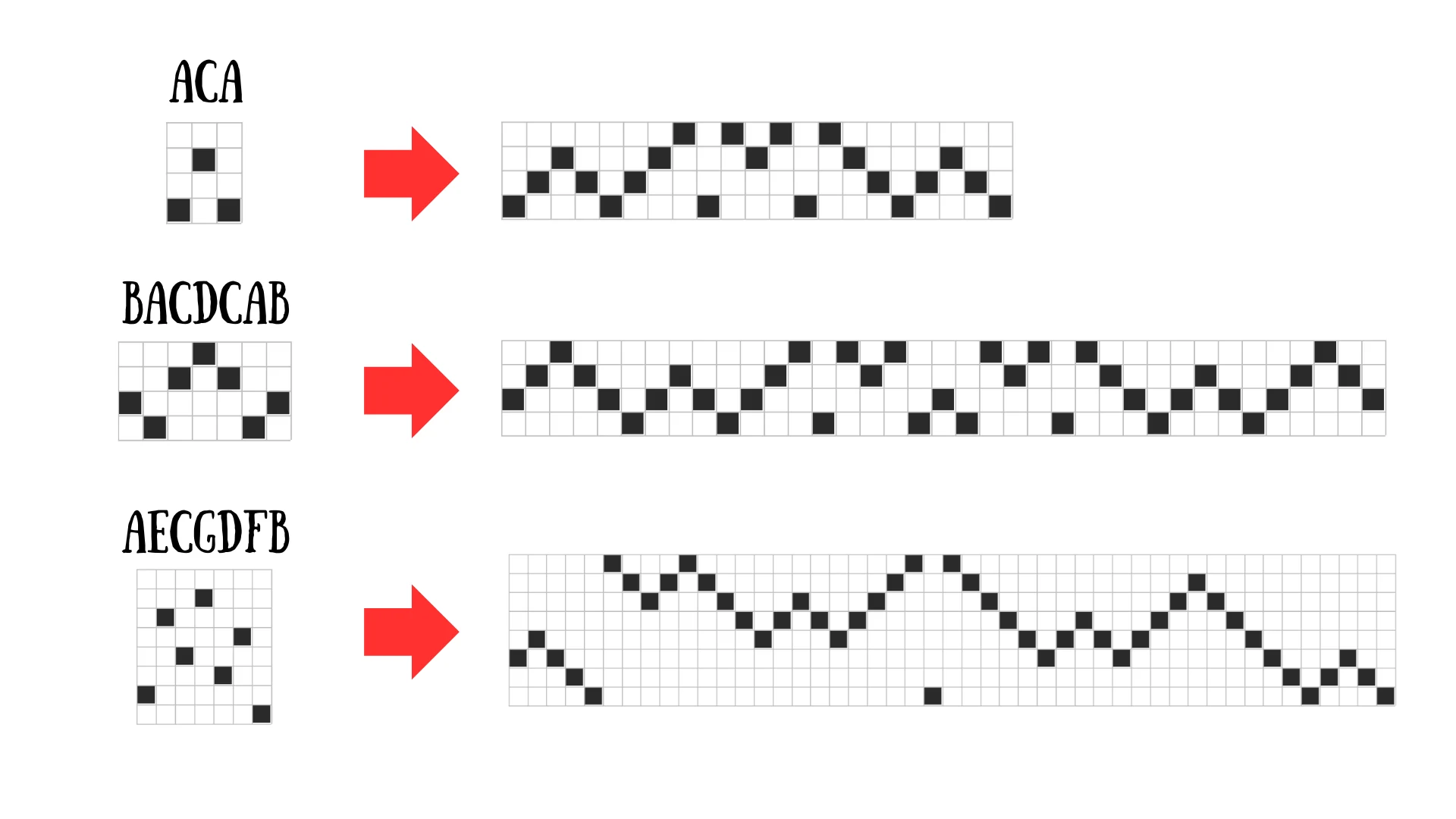
Här demonstrerar vi tre profilpatroner till (till vänster) med gap, och vi utför jämtlandsdräll-blocksubstitution med förbindelsetrådar (incidentals) för att få de fullständiga jämtlandsdräll-sekvenserna respektive (till höger).
Vi har inkluderat ett 8-skafts exempel som utnyttjar förbindelsetrådar för att få längre spetskypert-löpningar (dvs. bortom trepunktskyperter). Längre spetskypert-löpningar skapar större mönster i vävnotan.
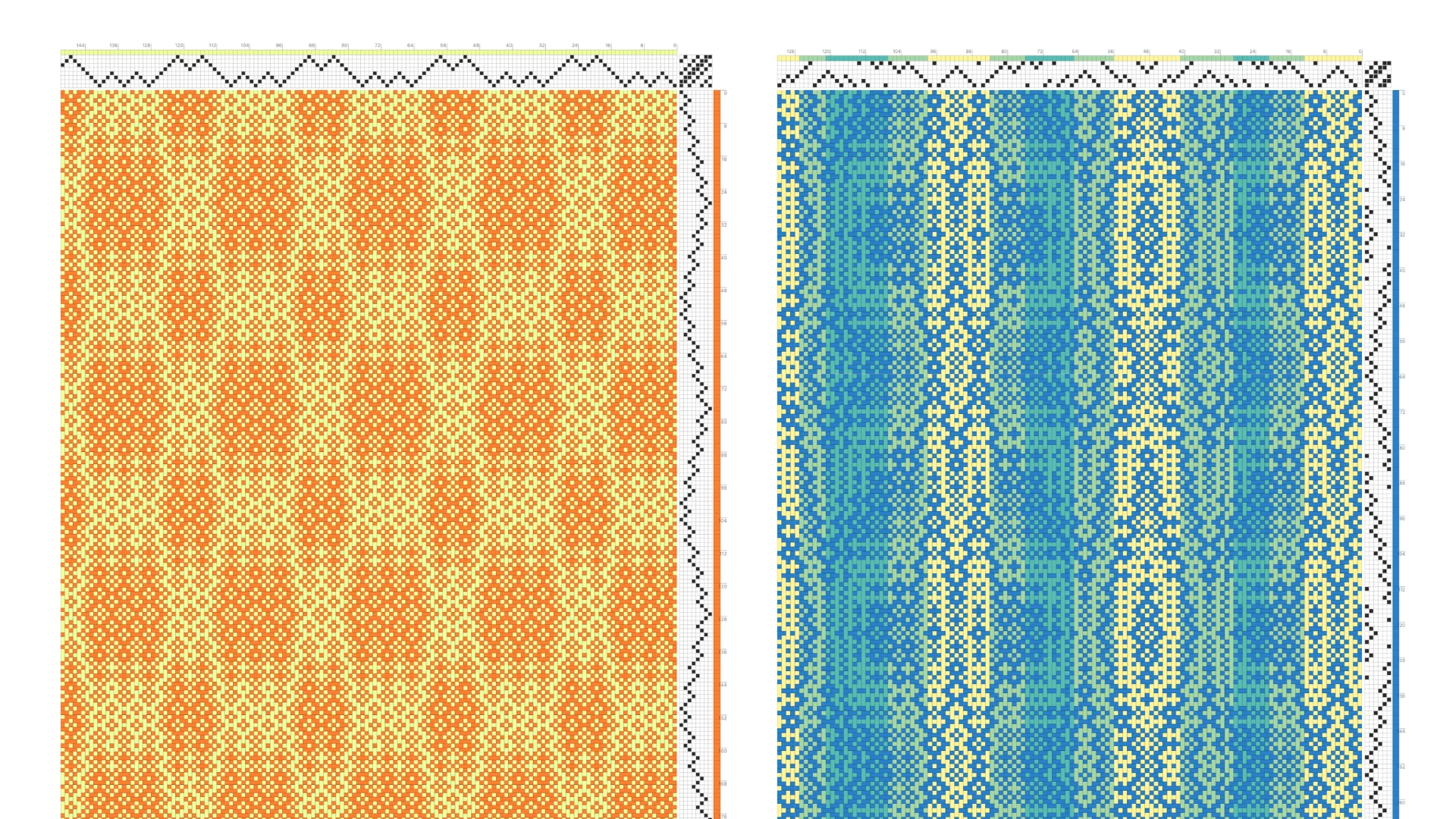
Slutligen vill vi dela exempelvävnotor som kombinerar allt som tagits upp i den här handledningen för att visa dig möjligheterna med jämtlandsdräll.
Till vänster har vi en jämtlandsdräll-vävnota på åtta skaft. Du kan lägga märke till de periodiska "topparna" och "dalarna" i både solvnings- och trampningssekvenserna som växlar och tar ut varandra för att skapa ett schackmönster.
Till höger har vi en jämtlandsdräll-vävnota på sex skaft. Du kan använda färggradienter för att framhäva jämtlandsdrällens fasstruktur för hänförande resultat.
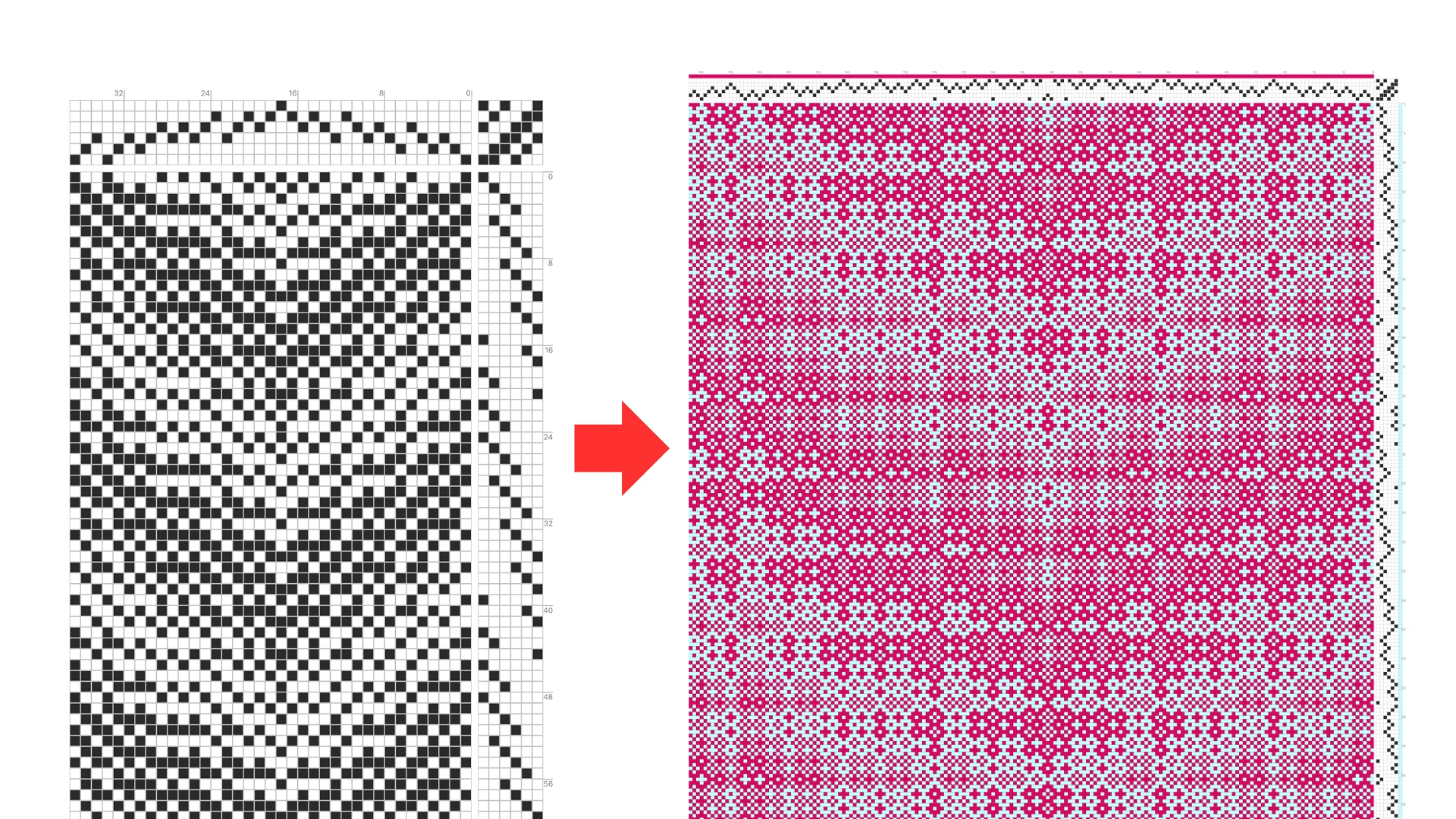
Här presenterar vi en komplex profilpatron som kan resultera i verkligt fantastiska jämtlandsdräll-vävar. De två olika stigande kyperterna i profilsolvningen och -trampningen skapar halvtonschevroner som löper nedför profilvävnotan.
Att använda blockexpansion med jämtlandsdräll återger halvtonerna med jämtlandsdrällens signaturplus och -punktformer. Så många möjligheter!
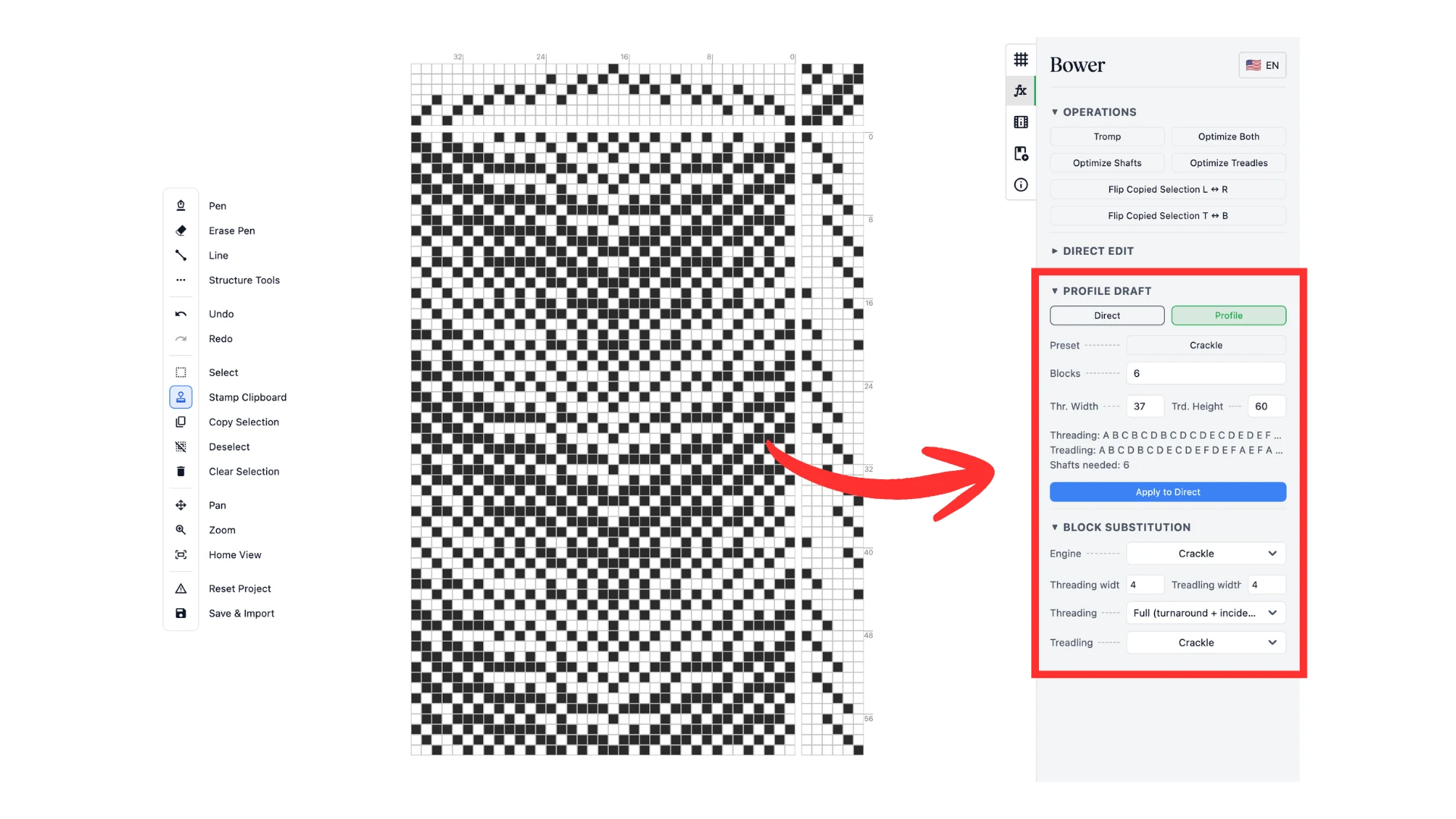
Återigen kan det vara mycket svårt att utföra jämtlandsdräll-blocksubstitution med en så komplex profilpatron.
Vi använde Bowers funktion för profilpatron och blocksubstitution för att göra detta automatiskt med ett enda klick!
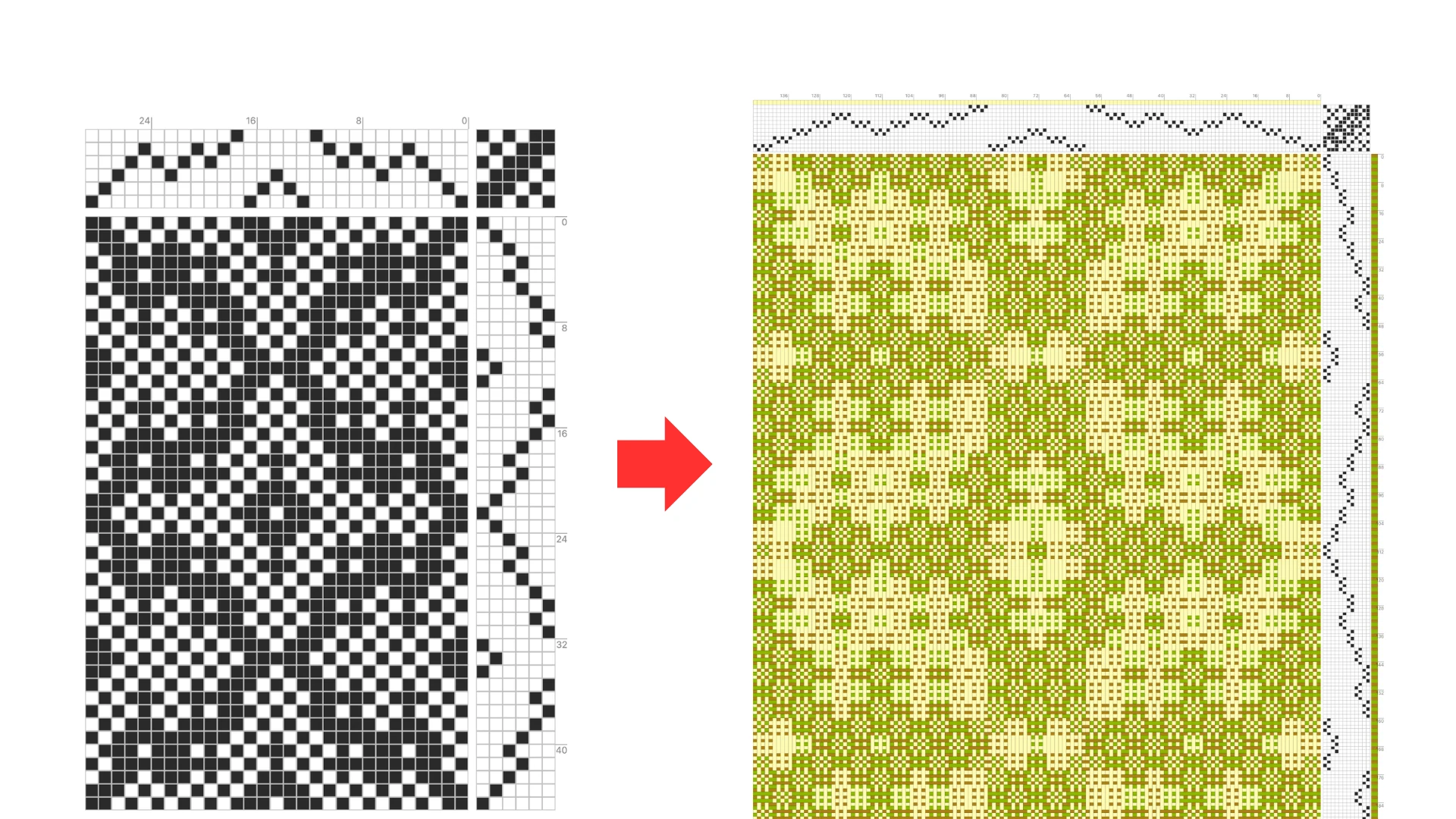
Slutligen kan vi använda en jämtlandsdräll-vävnota som profilpatron i sig själv och blocksubstituera en annan vävstruktur, såsom flerskafts-daldräll som visas i handledningsbilden. Detta kan ofta få ditt skaftantal att explodera men resulterar i galet hänförande designer.
Grattis! Du har lärt dig jämtlandsdräll i den här handledningen! Lycka till med dina nyvunna kunskaper och prova dem i Bower!