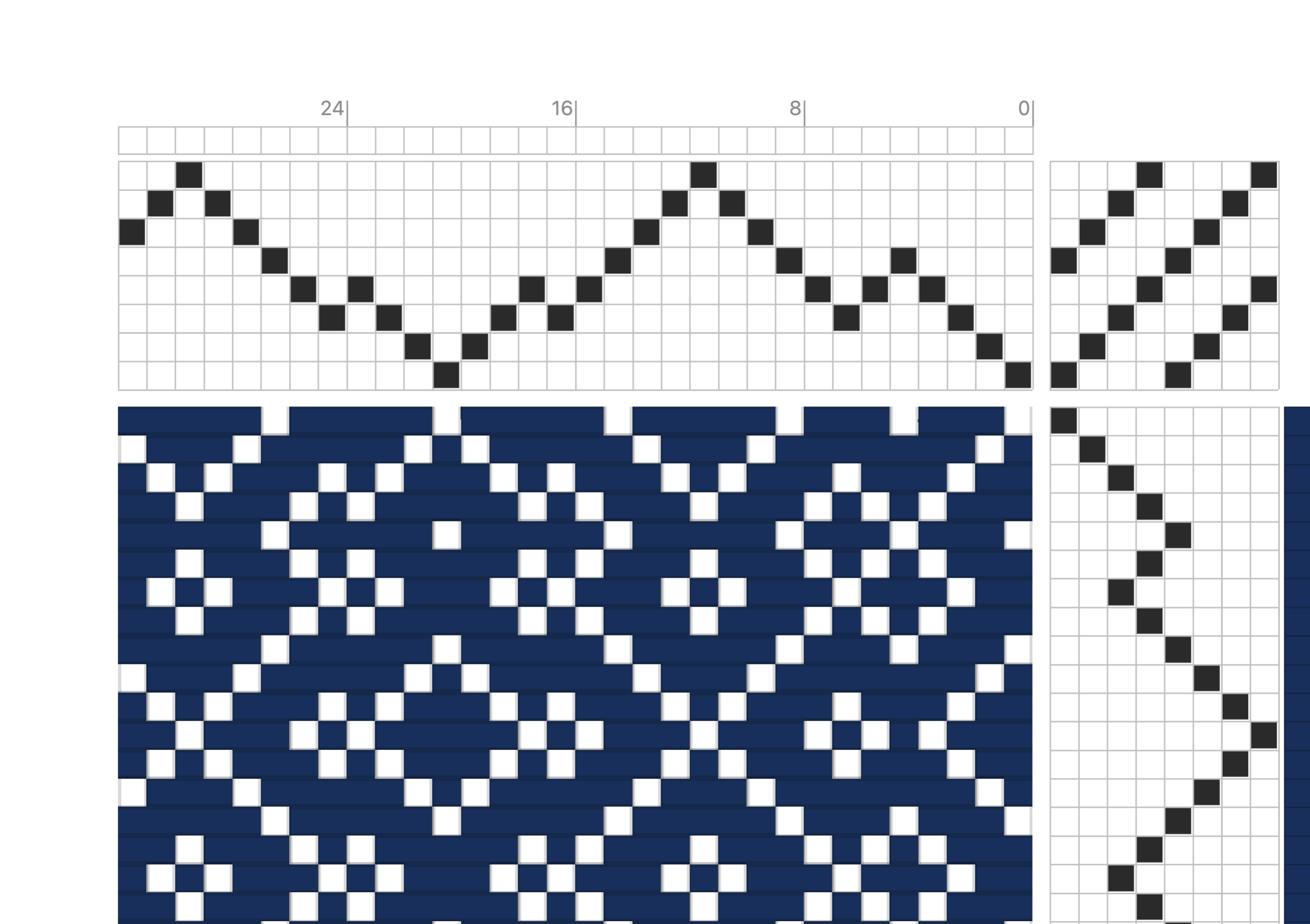
Twill Structure
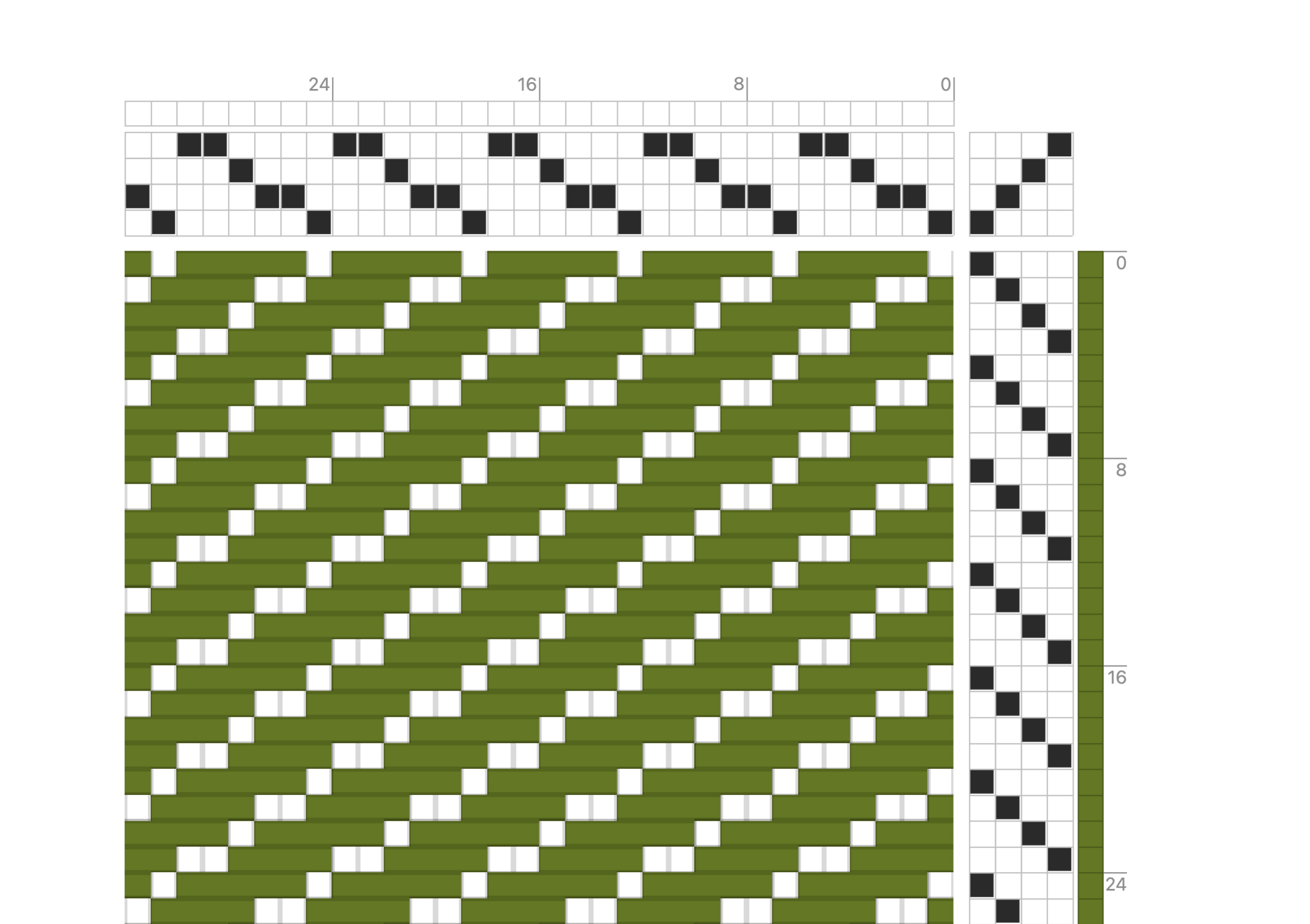
Twill produces a diagonal line across the cloth. Each weft pick offsets by one position from the last, and that steady offset is what builds the diagonal. The angle and texture of the twill line depend on the draft.
On a 4-shaft loom the threading and treadling for twill are always the same: a straight draw. Everything that changes about the cloth comes from the tieup. That simplicity is what makes twill such a good structure to learn on.
The Straight Draw
Open Bower and set your loom to 4 shafts and 4 treadles. Thread a straight draw across all your warps: shaft 1, 2, 3, 4, repeating. Set the treadling the same way: treadle 1, 2, 3, 4, repeating down the grid.
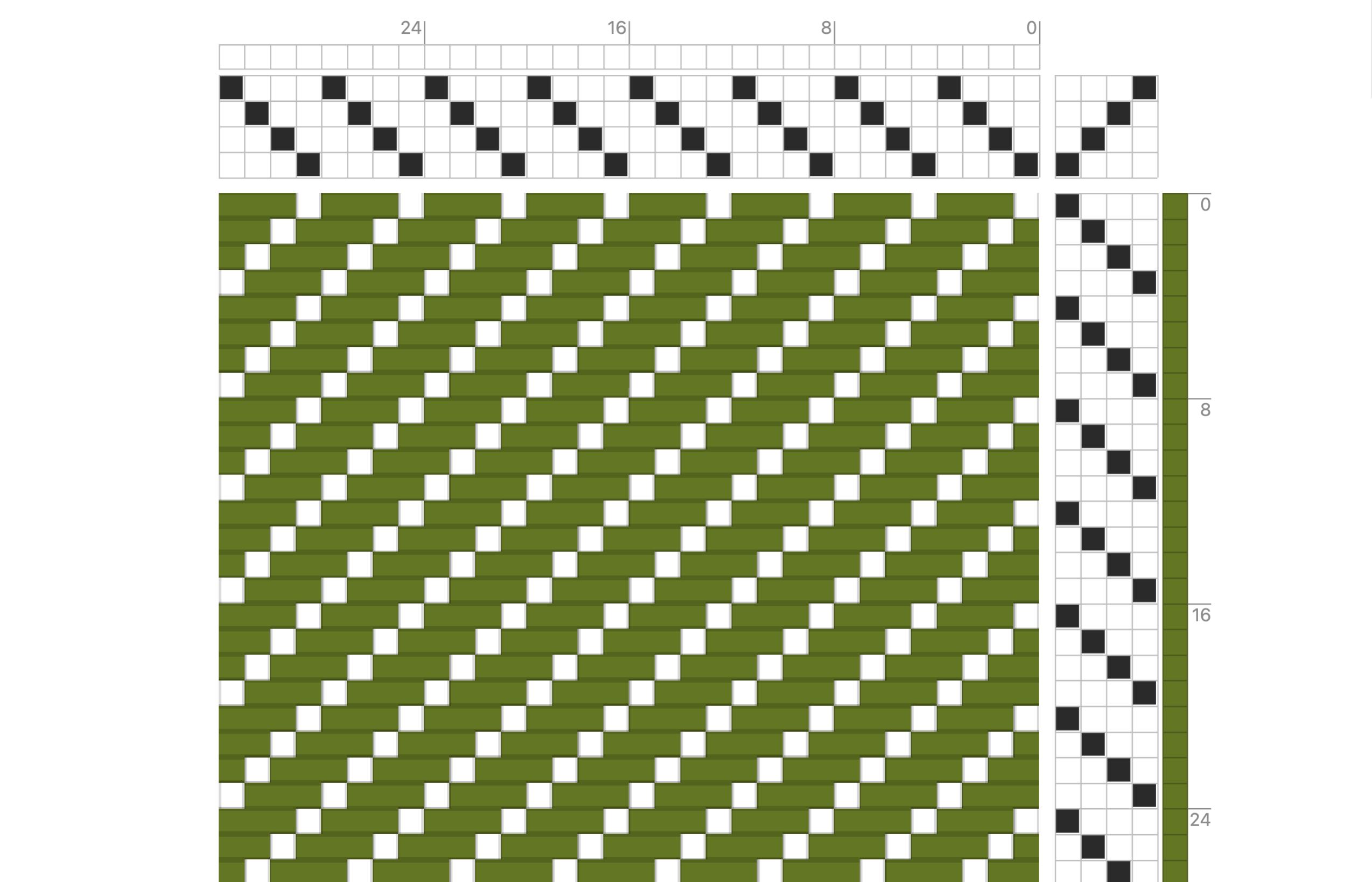
Tieups Define the Twill
The tieup connects shafts to treadles. Each filled cell means "when this treadle is pressed, raise this shaft." The number of filled cells per column sets the twill ratio, and the ratio controls how warp and weft share the surface.
2/2 Twill (Balanced)
Tie each treadle to two adjacent shafts: treadle 1 raises shafts 1 and 2, treadle 2 raises shafts 2 and 3, treadle 3 raises 3 and 4, treadle 4 raises 4 and 1. The drawdown shows a clean diagonal with warp and weft equally visible. Two up, two down at every crossing. This is the most common twill; denim is a 2/2.
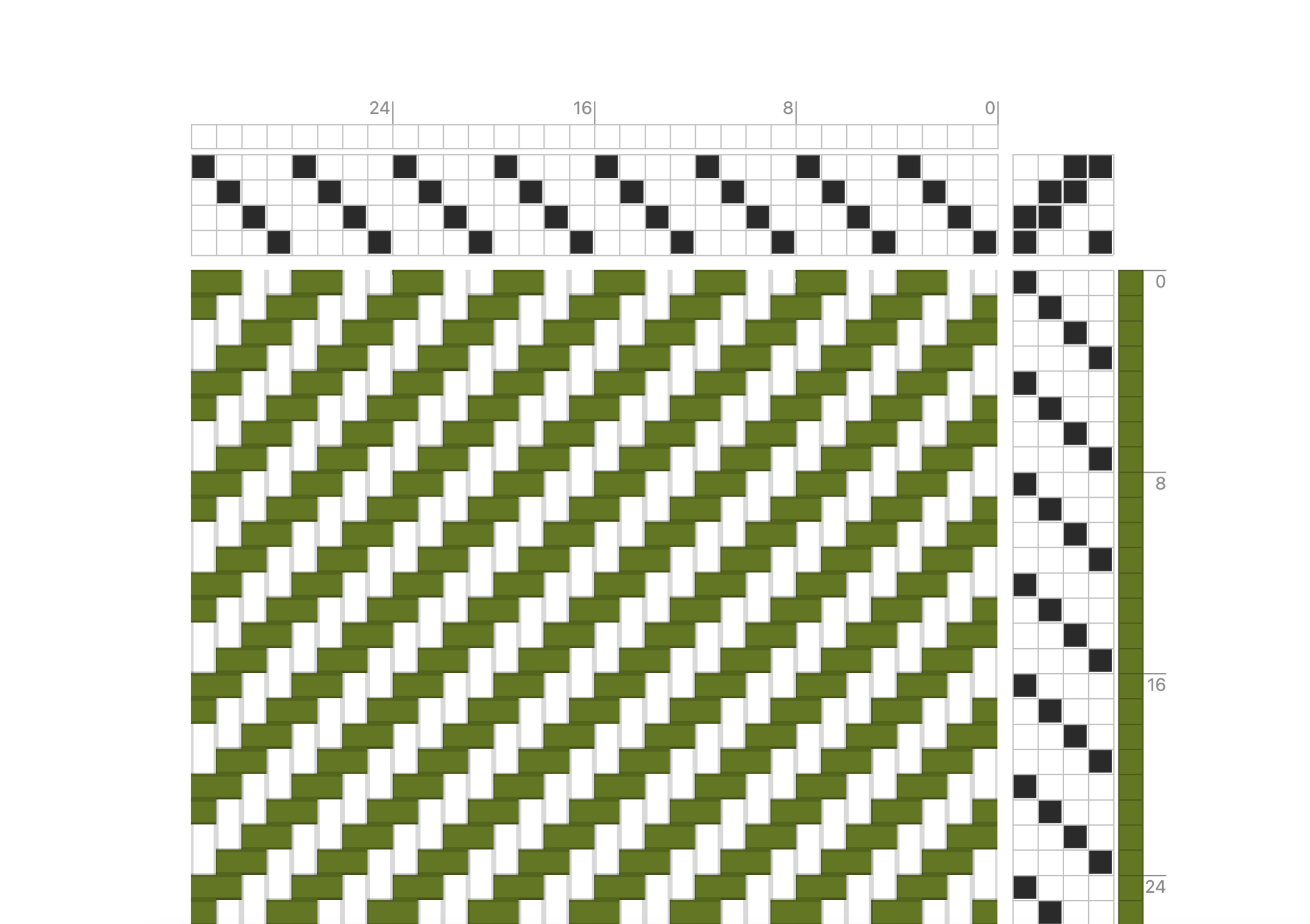
1/3 Twill (Weft-Dominant)
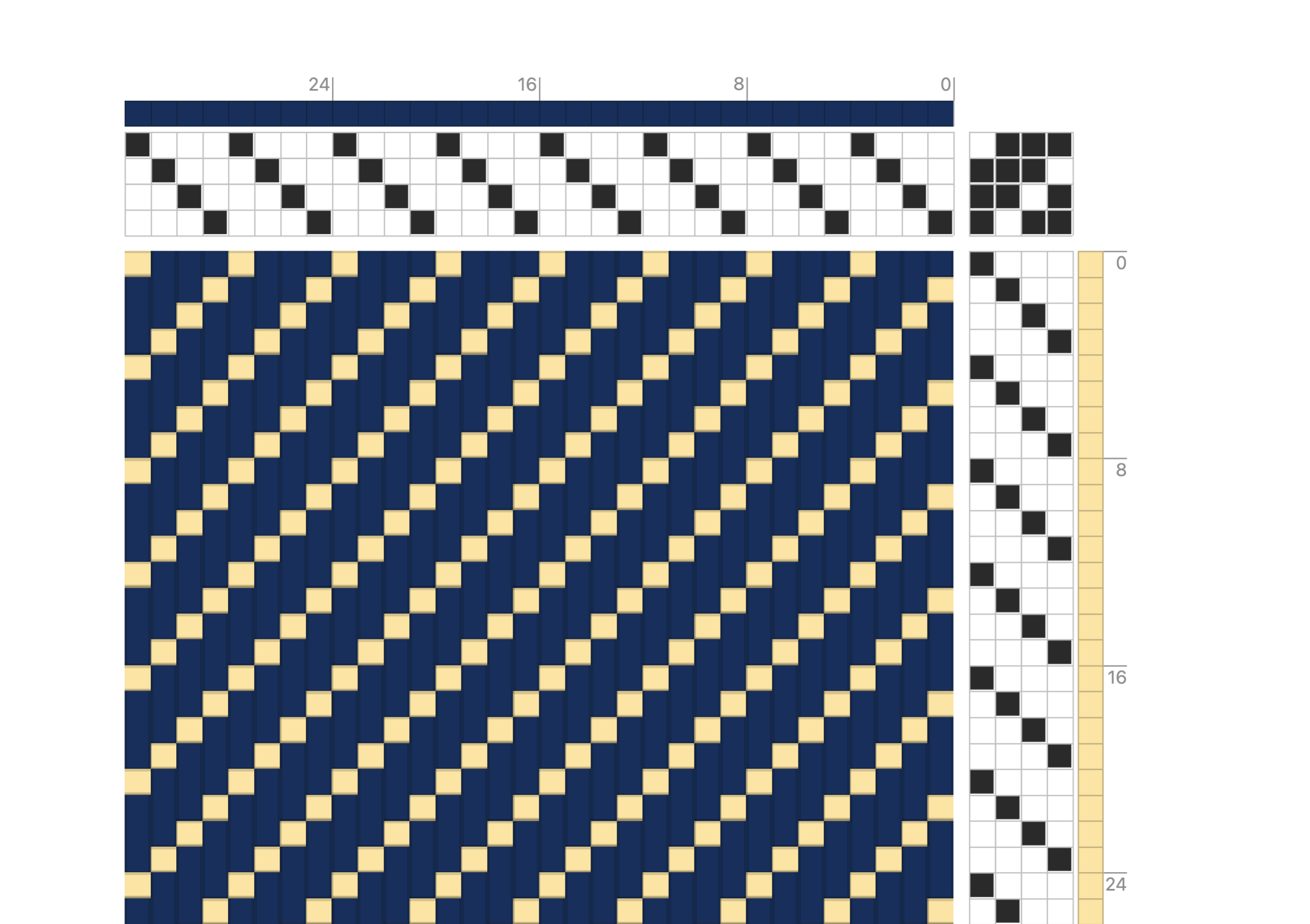
Tie each treadle to just one shaft. Only one warp thread rises per pick, so the weft covers three quarters of the surface. The diagonal is still there but the face shows mostly weft color. Flip the cloth and you see a 3/1 twill where the warp dominates.
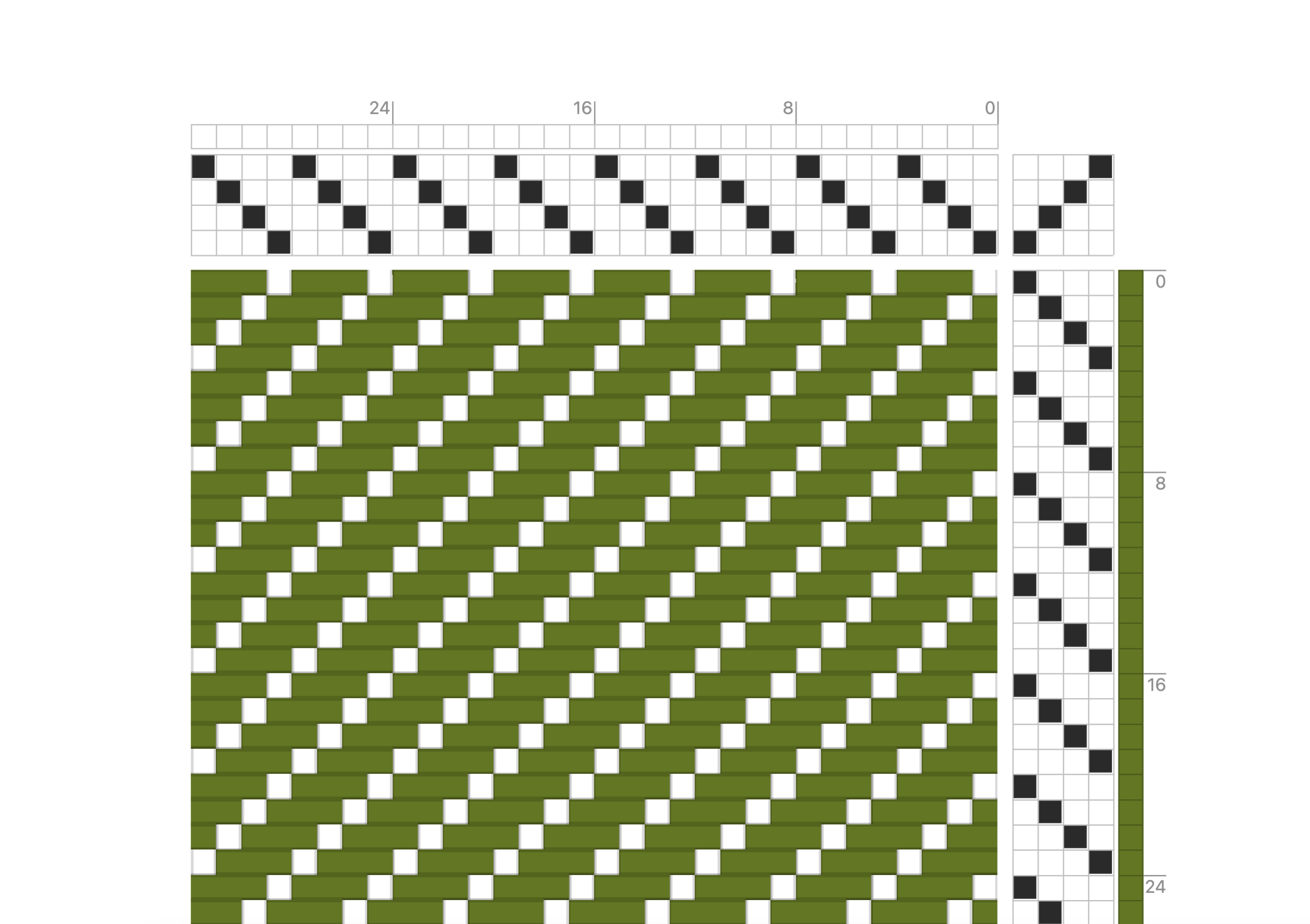
3/1 Twill (Warp-Dominant)
Tie each treadle to three adjacent shafts. Three warp threads float over each pick, so the surface shows mostly warp. Same structure as the 1/3 viewed from the other side.
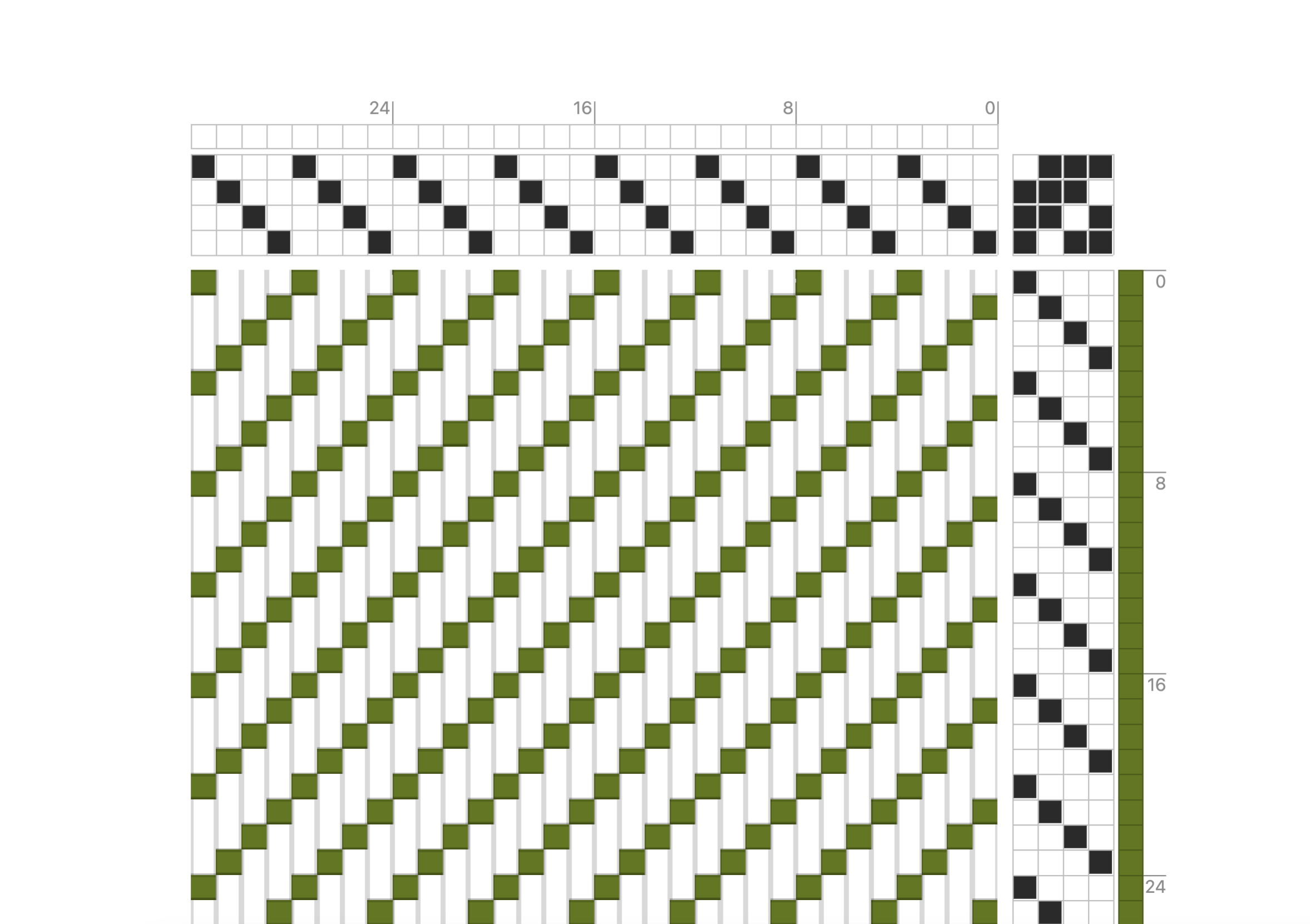
In all three cases the threading and treadling stayed the same. We got three different fabrics just by swapping the tieup.
Extended Twills on 8+ Shafts
Resize your loom in Bower to 8 shafts and 8 treadles. Keep the straight draw and straight treadling. A 2/2 on 8 shafts produces the same cloth as on 4, so the reason to use more shafts is ratios that don't fit on a smaller loom.
3/5 Twill
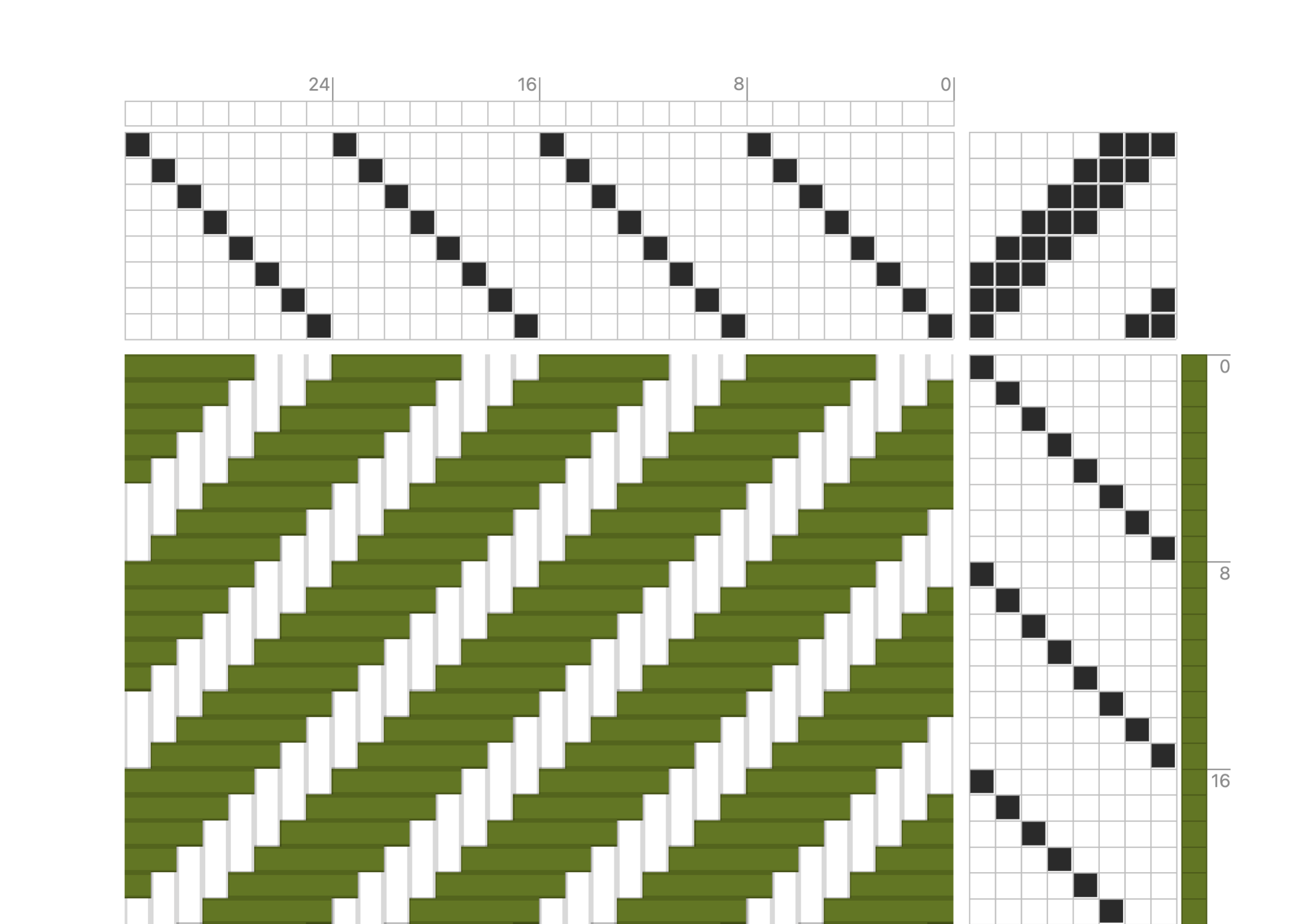
Tie each treadle to three adjacent shafts. Three warp threads rise per pick and five stay down, so the weft dominates the surface. The longest float is five threads, which keeps the cloth stable enough to handle without special finishing. You can't get this ratio on 4 shafts.
4/4 Twill
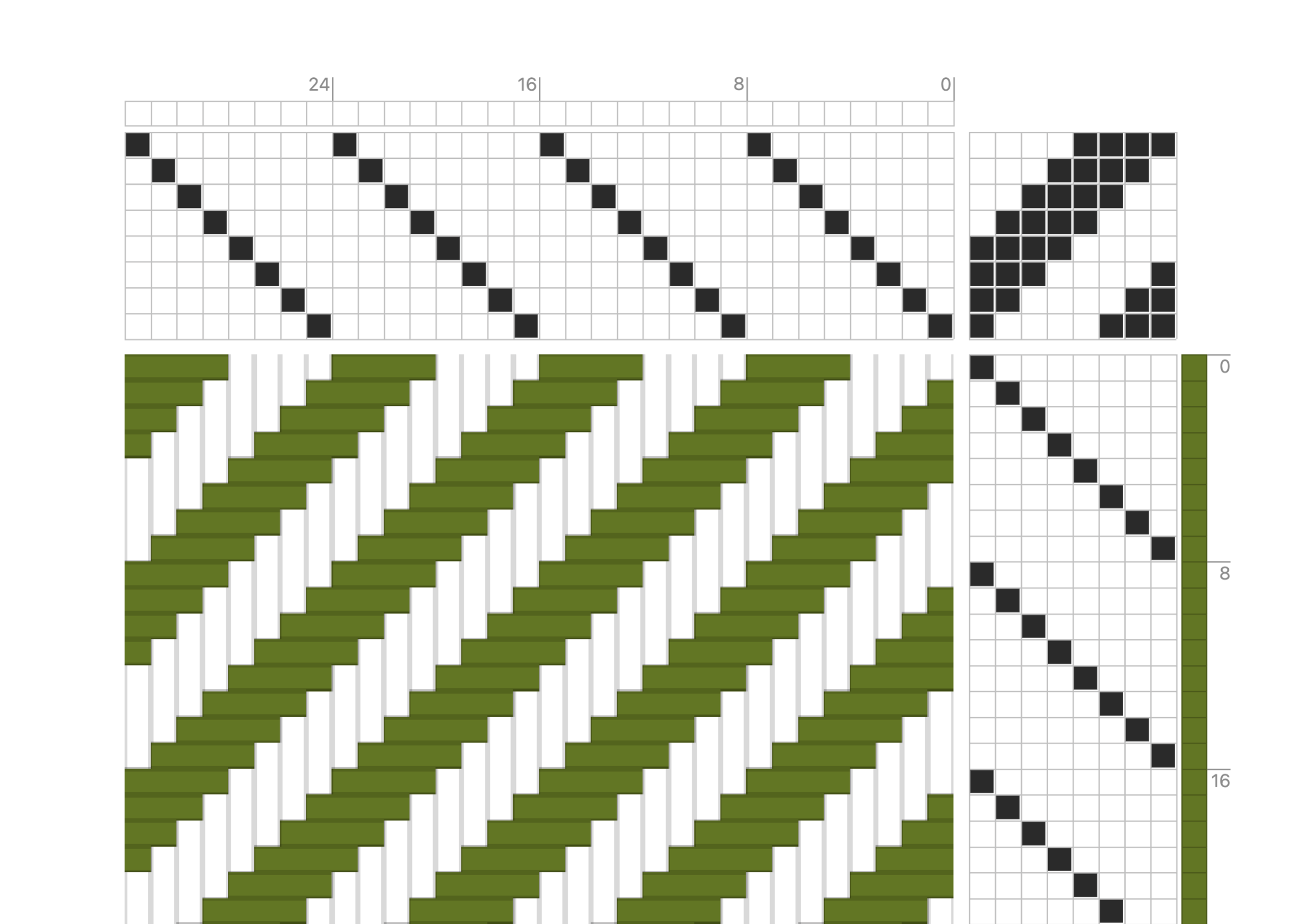
Tie each treadle to four adjacent shafts. Four up, four down at every crossing, so warp and weft share the surface equally. This is the 8-shaft balanced twill. It looks like 2/2 in structure, but the floats are twice as long, which changes the hand and drape of the cloth.
Mixing Ratios
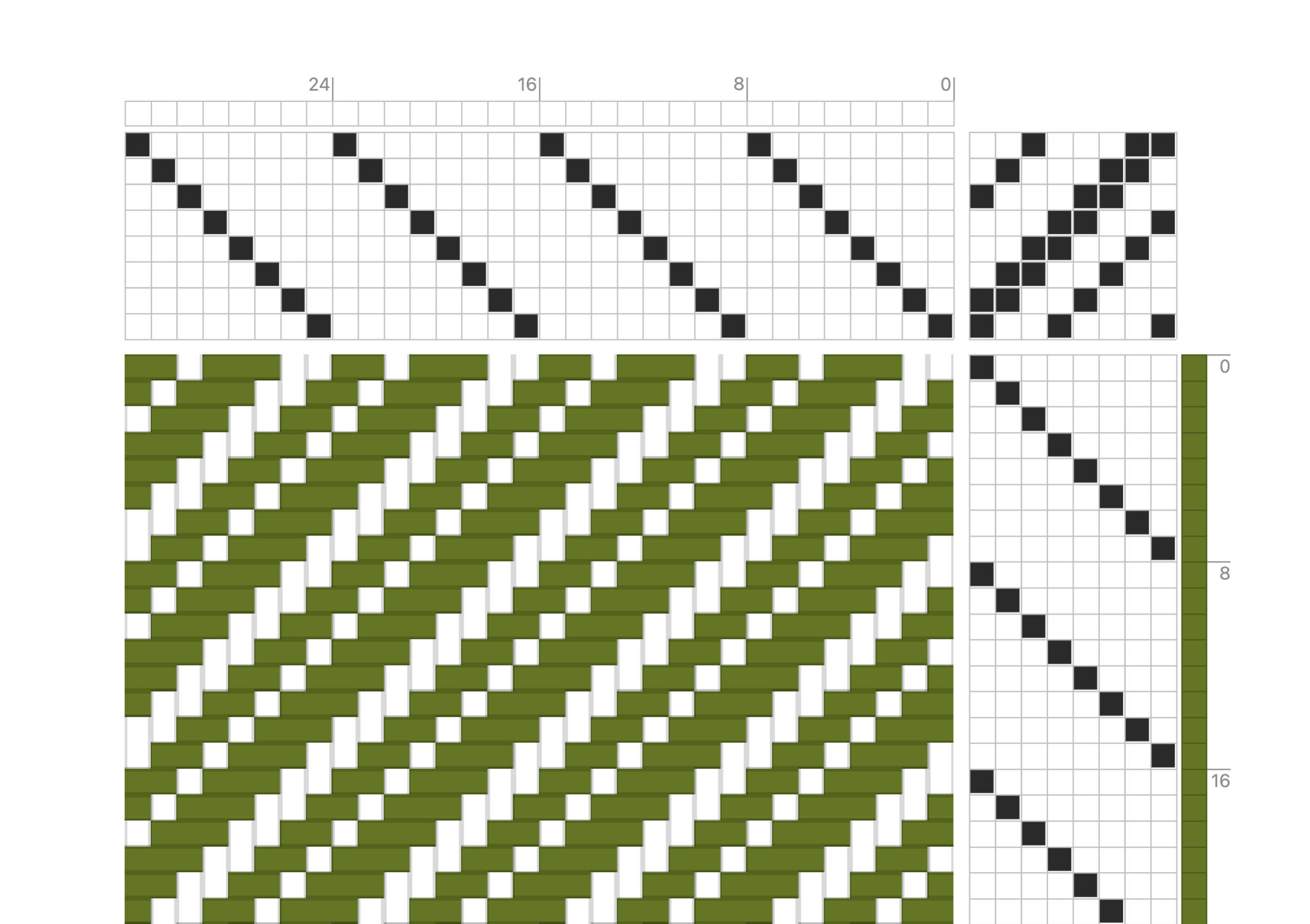
Extra shafts let you "combine" ratios within a single repeat. Try a tieup where you superimpose a 2/2 twill pattern and a 1/3 twill pattern. Notice how we divy up the area of the 8x8 tieup into two 4-wide diagonal stripes. The drawdown produces alternating bands: thin weft-dominant diagonals next to thicker balanced ones. You can't do this on 4 shafts.
Irregular Twills
You can also build a threading that breaks from the straight 45-degree diagonal lines. Try adjusting the threading to repeat shallower lines and steeper lines. You can also do the same with the treadling. This is a departure from normal twills but is very fun!
Color and Twill
The twill ratio controls how much warp versus weft shows on the surface, so the colors you choose for each interact in predictable ways.
Same-Color Warp and Weft
With the same color in both systems you see the twill diagonal only through texture and sheen. The floats catch light differently on each face.
Contrasting Warp and Weft
Put a dark warp with a light weft. A 3/1 twill shows mostly dark because the warp sits on top. A 1/3 shows mostly light. A 2/2 blends them into a mid-tone. The tieup acts as a color dial.
Color Stripes in the Warp and Weft
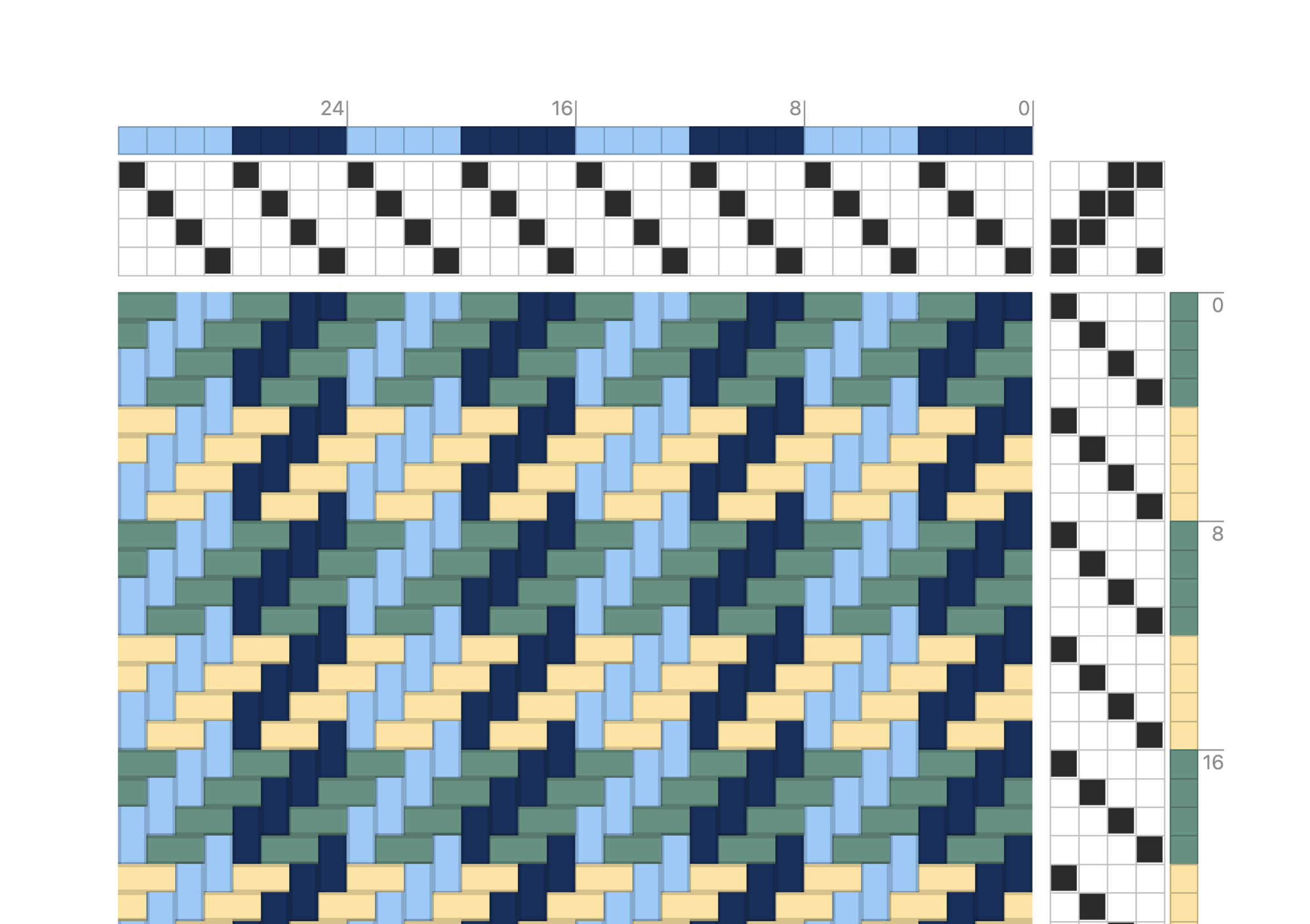
Thread alternating color stripes in your ends, say 4 dark warps then 4 light. Do the same for your picks. The twill structure blends the colors together, opening a world of optical color mixing for you to explore.
Color for Emergent Structure: Houndstooth
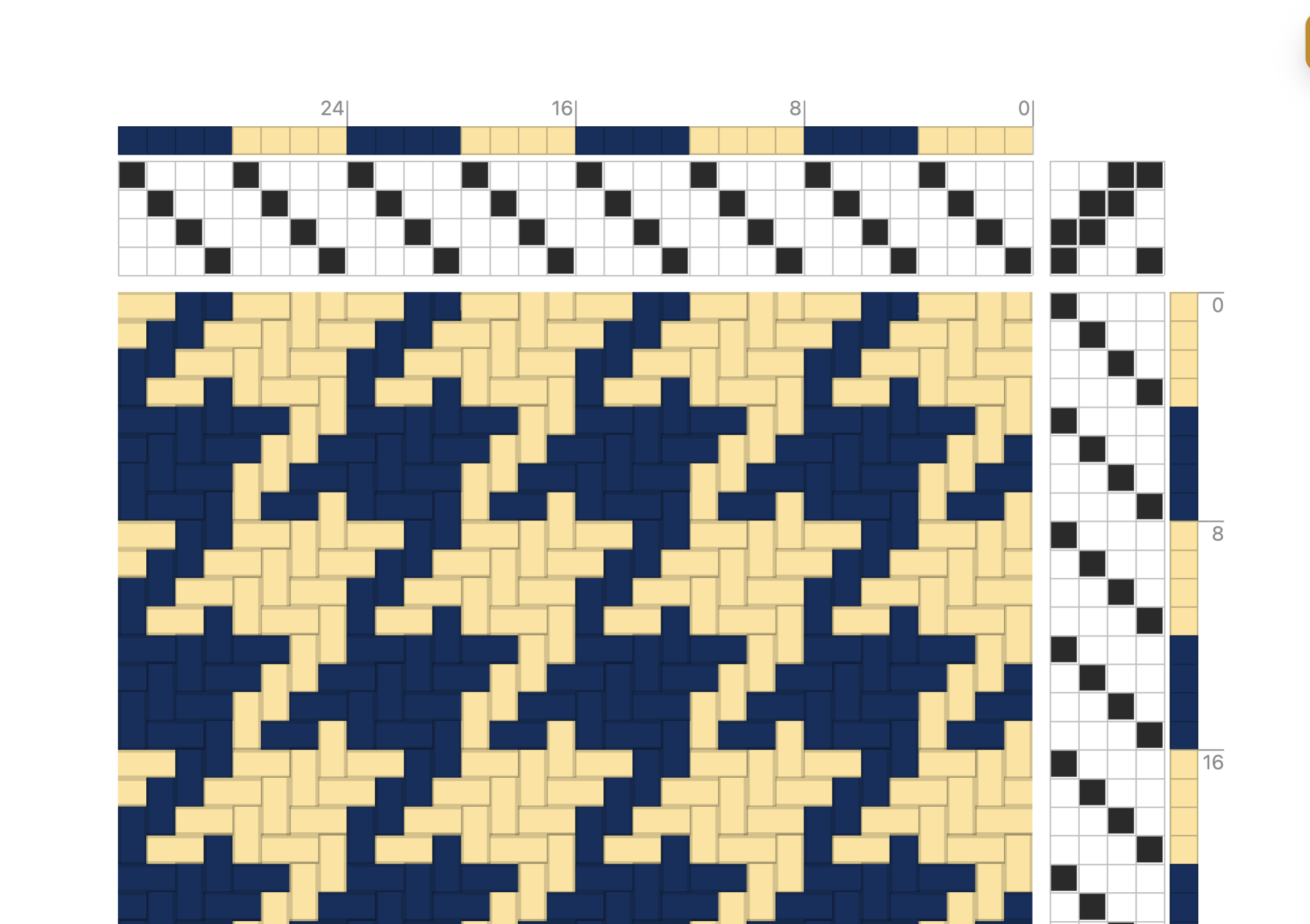
Thread alternating pairs of light and dark warps (4 light, 4 dark, repeating) and use the same alternation in the weft. With a 2/2 tieup this produces houndstooth. The pattern comes from the interaction of color order and weave structure, not from the tieup alone. Wider color groups make larger checks.
Breaking the Diagonal
Everything above used a straight draw threading. That straight draw is what makes the diagonal continuous. We can change the threading itself to redirect the diagonal while keeping the same tieup.
Point Twill: Chevrons
Reverse the threading at a peak: 1, 2, 3, 4, 3, 2, 1, 2, 3, 4, 3, 2, repeating. This is a point draft. The diagonal climbs to shaft 4 then turns around, making V-shaped chevrons in the drawdown.
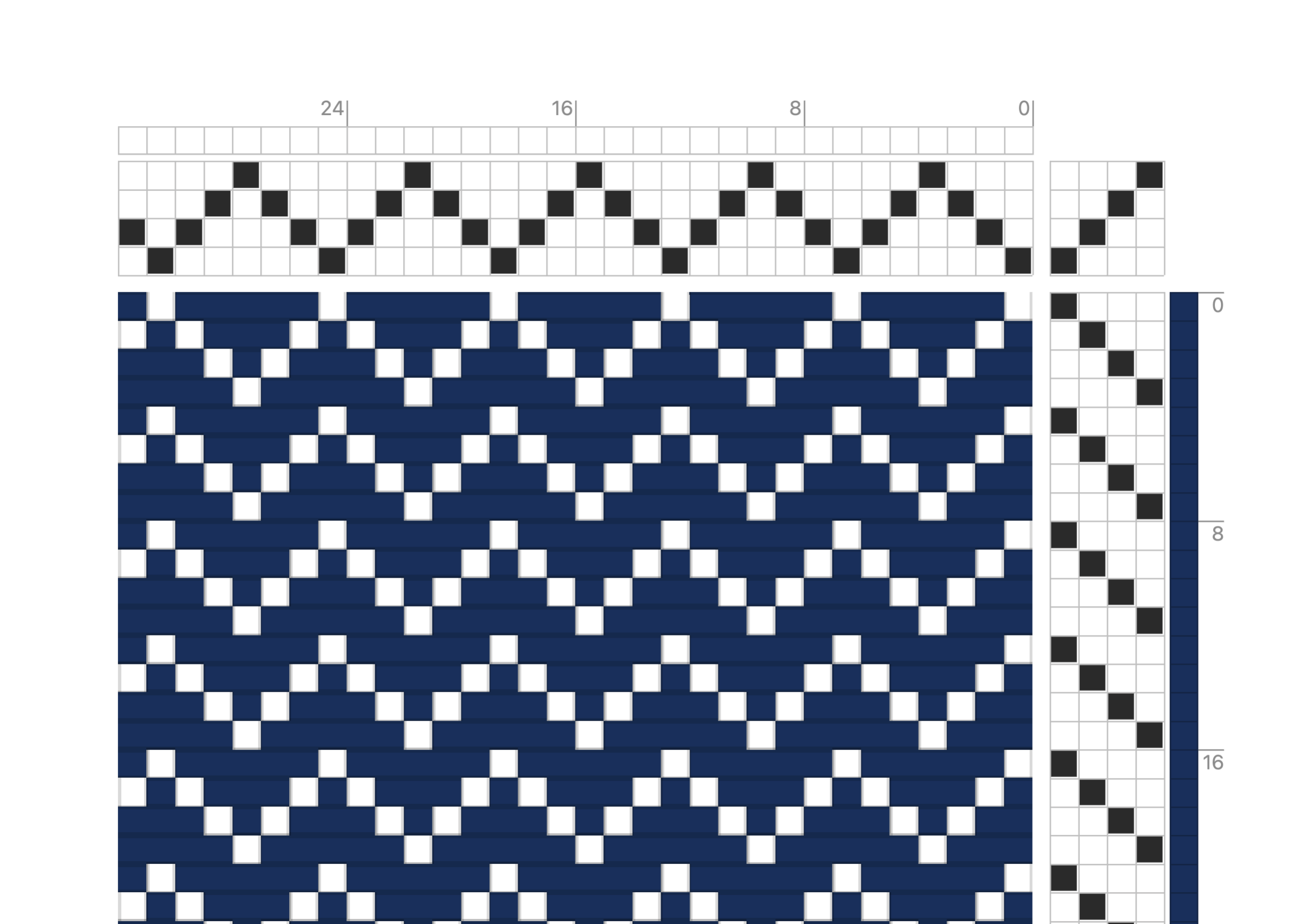
You can apply the same reversal to the treadling too. A point threading with a point treadling gives a full diamond motif, mirrored both horizontally and vertically.
Reversed Point Twill: Larger Chevrons
Take the point twill but flip its orientation on every repeat. You can see opposite point twill "V" shapes connect to create structures that span double the shaft count; in the following example we've obtained chevrons that repeat every 14 ends instead of the previous 6 ends.
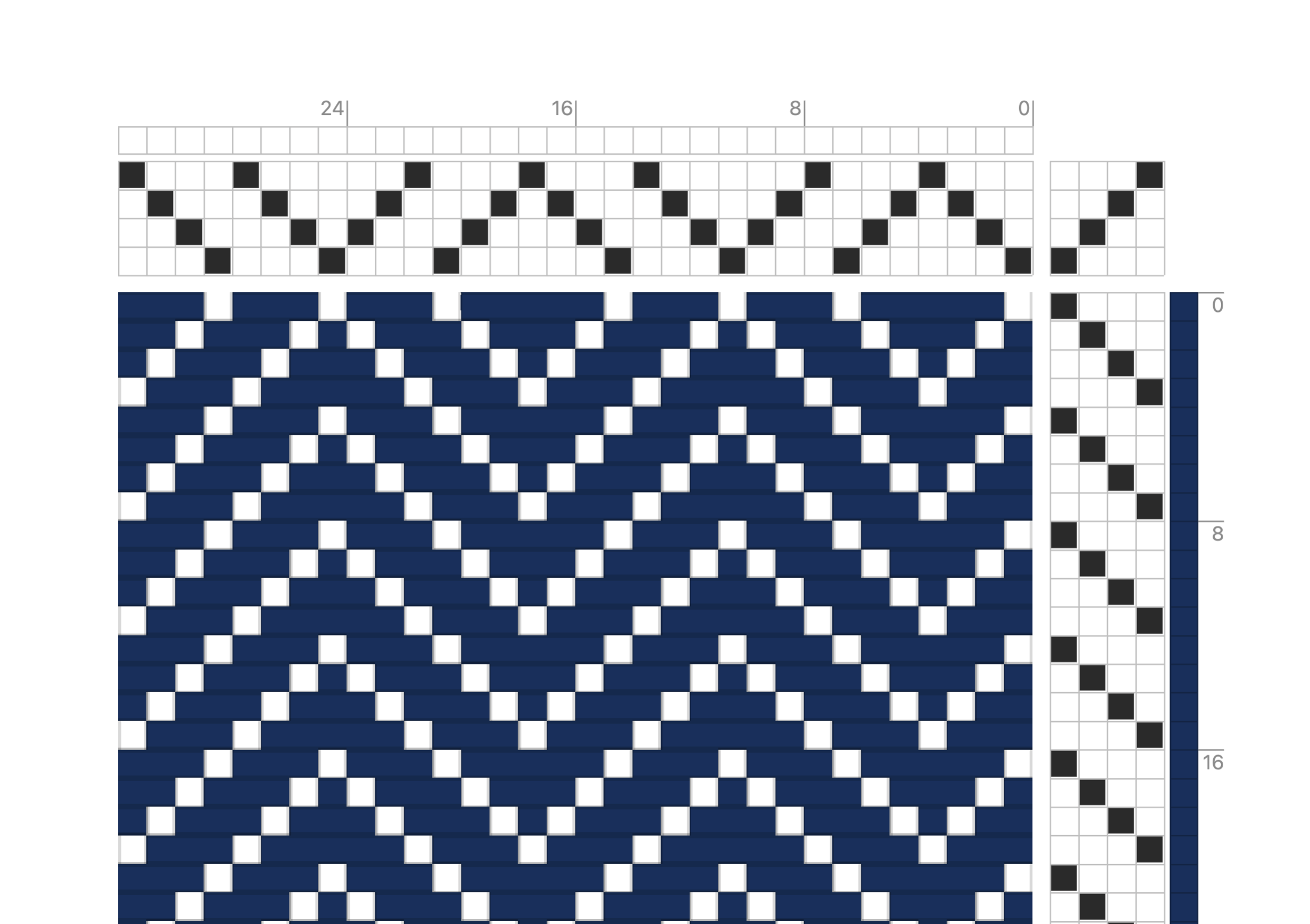
Zig-Zag Twill: Aliased Ripples
Interrupt the straight line threading/treadling so a diagonal can't build momentum. Instead of reversing after a full 1-2-3-4-5-6-7-8 climb, reverse every 3 or 4 threads: 1-2-3-4-5-4-3-4-5-6-7-8 or even 1-2-3-2-3-4-3-4-5-4-5-6 and so on. The diagonal breaks into jagged runs that interfere and create unexpected results in the drawdown.